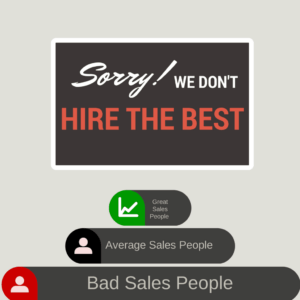
We see it all the time. A great sales candidate meets with a prospective employer who rejects the candidate and elects to hire someone else. Oftentimes the reasons are legitimate – such as poor cultural fit – but many times, there are no logical reasons for the decision not to consider the candidate who would in all likelihood otherwise be a strong producer.
When reliable sales talent is in such high demand because it is so important to the success of any business, excluding great sales candidates from the hiring process for the wrong reasons is a real issue. There are several reasons why this happens:
Top Performing Sales People Are Different – If you spend any time with sales people who consistently perform at or above targets, you will quickly see they are different than the average sales person. The over-achievers possess higher drive and ambition, are more competitive, and exude confidence. While these are the traits that lead to sales success, they can be misinterpreted as liabilities, as Joseph Skursky noted in his post, Sales Thoroughbreds: The Key to Winning New Business, “the very nature and intensity of a hunter’s personality frequently turns off some recruiters and people in HR.”
Top Sales Talent Is Rare – As Colleen Francis points out in her book, Nonstop Sales Boom, only 20% of reps consistently hit well above their targets. Since the vast majority of applicants and the majority of sales people employed are average or below average sales people (see John Kearny’s post, Is Your Talent Hurting Your Sales Initiatives?), hiring managers are often not conditioned to spot them and instead are looking for more of what they are used to – average sales people.
High Producing Sales People Are Employed – Great sales candidates are not sitting at home waiting for a call from a new employer. Sales people who are consistently at or above target are busy producing sales for another employer. And being paid well to do so. Any employer trying to recruit one of these may find that they may not be as enthusiastic as another unemployed candidate who desperate for a job; any job. Often enthusiasm is mistaken for ability and a hiring manager focuses on the sales person they can easily hire rather than the sales person that will produce the desired sales results.
Broken Hiring Processes – In many companies, the hiring process is disjointed. Multiple people are involved in the hiring decision without clear and shared hiring criteria. This leads to confusion about the traits the employer is seeking and some great candidates can get nixed because someone misunderstands the hiring needs. Furthermore, it is often the case that people involved in the interview and hiring process have no formal training on how to interview or select candidates (in case you need it, here are some tips on how to interview sales candidates). As sales expert Dave Stein points out, “a key to successful hiring is objectivity. Hiring salespeople on gut feel, the old-fashioned way, doesn’t work.”
It takes a lot of hard work and effort to attract and hire great sales people. High producing sales organizations know that the odds of attracting sales talent is greatly increased when top performing sales people are immediately recognized and given the attention they deserve.
Before Peak, Eliot spent more than 20 years building and leading companies, where he took the lead in recruiting and managing high performance sales teams. He co-founded Ventrada Systems (mobile applications) and GlobalX (e-commerce software). He was also Vice President of Sales for PointShot Wireless.Eliot received his B. Comm. from Carleton University and has been honored as a Top 40 Under 40 Award winner.
He co-authored Sales Recruiting 2.0, How to Find Top Performing Sales People, Fast and provides regular insights on sales team management and hiring on the Peak Sales Recruiting Blog.
As we have written about before, top performing B2B sales people want to work for industry leading and highly reputed companies which their chances of success are greatest. Since there is excess demand for the services of top sales people, why wouldn’t they be selective in who they work for? In an Internet dominated world, a key question for employers is how much value the best sales professionals assign to the online reputation of an employer when deciding whether or not to be engaged in their recruiting process? And, what can I, as an employer, do to ensure that our online presence and reputation doesn’t interfere with recruiting efforts?
How much does online reputation matter for employers?
Top sales professionals, whether they are a rep or a sales VP, are passive. They are leaders in their space because they not only hit, but exceed their sales goals year after year. They win deals because they do their due diligence on prospects and don’t waste time; they are efficient. Furthermore, they have excellent compensation packages and are not usually interested in making a move because they are set-up to succeed in their current role. So when trying to attract the best-of-the-best, it is important that you, regardless of your position in the company, ensure your company puts its best foot forwarded when headhunting ‘A’ level sales candidates.
Often, the first exposure a candidate will have with your company is online. Perhaps the candidate will enter the url of your company and check out the website directly. Most likely, candidates will Google the company name to see what top search results are returned. Usually sites like the organization’s LinkedIn company page and Google+ page will be high on the list. But remember how top sales performers do their due diligence, instead of stopping at a basic Google query, they will enter “company X + reviews” or “working at company X”. These searches can return information that will make or break your sales recruiting efforts.
In this day and age, companies that don’t have an exceptional online presence are simply not going to attract A level talent”
Perhaps the most important detail that candidates look at is, of course, customer reviews. These reviews are arguably the lifeblood for an organization since they are tell-tail factors of whether or not the product or service provided has actually been embraced by the market. Things like business awards, a testimonial page, case studies, and a sizeable social media following (depending on B2B vs B2C organizations) do most of the ‘talking’ about where your organization ranks at the end of the day. Bottom line, if your organization has no ‘proof’ that its deliverable has a fan base, you can forget about attracting the best-of-the-best.
In a close second to customer reviews are employee reviews. Often posted by past employees, but sometimes posted by current ones, online sites like Glassdoor.com, Indeed.com, LinkedIn, and Vault.com provide an avenue for candidates to be armed with a dump truck full of knowledge about their potential employer. While the reviews posted on sites like those listed above are often, and rightfully so, taken with a grain of salt by candidates, their ability to influence should not be underestimated.
Monitor and Develop
Luckily there is a way to fight back, especially against those employees who left with a sour taste in their mouth. It’s simple, world class employers not only showcase their customer’s rave reviews but actually quote some of the things current employees are saying about why they love to work at their company..
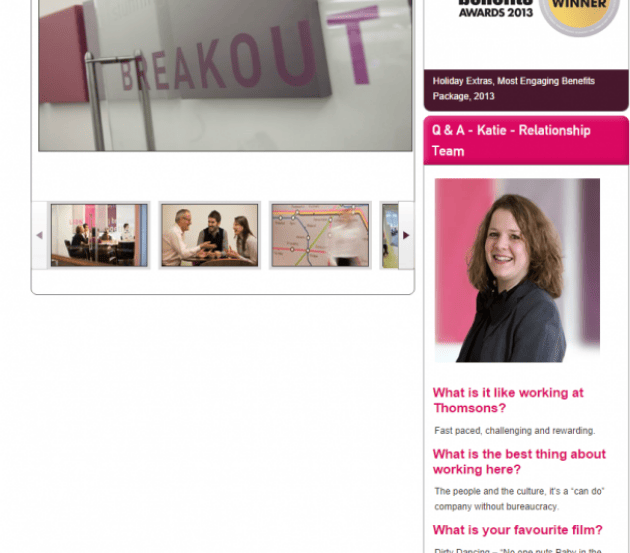
Take one of our favorite clients, Thomson’s Online Benefits, for example. Not only do they talk about their “bright, clean, modern and just a little bit different” working space, but they also talk about how keeping their employees healthy and “alleviating those mid-afternoon energy slumps” by providing a “seasonal selection of free fruit in the office.” Furthermore, as you can see in the picture below, they actually showcase their Pay and Benefits awards and have a short Q & A with one of their team members on what it’s like working there.
Show casing awards and the working environment are just a few of the ways your organization can amplify its online attractiveness to ‘A’ level sales talent. Try doing a case study of on one of your reps that has rising up the ranks. In it, be sure to identify what originally attracted the candidate to the organization, how management provided the tools for the candidate to succeed from day one, and how they are now impacting the current working environment. Put it this way, just as sales prospect respond best to the success of others, so do sales candidates.
Another option which Human Resources and your organization’s Marketing department could undertake is to conduct a short, 2-3 minute video interview with the President or CEO where he or she discusses why your organization is a great place to work and make a fantastic living. If you are hiring a sales rep, do a video with the individual who would be managing them too.
Bottom line, in the war for talent, it is worth investing to ensure that your company looks and sounds it’s best online since an active, positive online reputation is one of a firm’s most strategic and valuable assets.
TIP: work with your marketing and PR departments to fine-tune your online presence.
Before Peak, Eliot spent more than 20 years building and leading companies, where he took the lead in recruiting and managing high performance sales teams. He co-founded Ventrada Systems (mobile applications) and GlobalX (e-commerce software). He was also Vice President of Sales for PointShot Wireless.
Eliot received his B. Comm. from Carleton University and has been honored as a Top 40 Under 40 Award winner.
He co-authored Sales Recruiting 2.0, How to Find Top Performing Sales People, Fast and provides regular insights on sales team management and hiring on the Peak Sales Recruiting Blog.
Let’s be honest. Not all sales conferences are created equal. You probably don’t even remember the worst conferences you ever attended. After all, they were far from memorable, but suffice it to say you ducked out as soon as possible, feeling like you would never get that time back. With so many conferences to choose from, and so many that don’t live up to their promises or can’t justify your time, how do you make sure you pick one that’s worth your time (and money)?
Use a Structured Approach:
Like everything we advocate in our sales hiring philosophy, we believe in a structured approach. Haphazardly selecting conferences to attend and showing up without any preparation leaves conference ROI to chance. We recommend following a defined process to help ensure the next sales conference you attend is a catalyst for real results.
Don’t worry; it’s easier than it sounds.
Set Desired Outcomes:
Start by jotting down some outcomes that would make a sales conference worthwhile for you.
Here are a few we came up with:
Network with thought leaders, peers, new client prospects, and potential sales team recruits.
Gather competitive intelligence for benchmarking, insight, and strategic planning.
Brainstorm new ideas to improve your company’s processes and performance.
Learn from industry experts sharing their own successes and failures, tactics and strategies, and tools and technologies.
Sell your company’s services to existing and new leads when relevant and appropriate.
Get actionable insight on the trends, developments, and forecasted changes in your industry.
Determine Selection Criteria:
Now that you know your desired outcomes, use them to come up with appropriate selection criteria to determine the conferences that are most likely to produce those outcomes.
For example:
Large (250+) number of participants.Why? Higher attendance means more chances to broaden your network, gain actionable insights, and uncover new opportunities.
Targeting B2B sales executives and managers. Why? The content will be tailored specifically for you!
Cost $300 or more to attend.Why? Amazing speakers deliver amazing value…and charge for it.
Pick a Conference:
We used the above criteria to compile our own list of 2015 sales conference recommendations:
Hosted by Selling Power, this is a high profile series of events typically held in four or five different U.S. locations each year. The Sales 2.0 conference focuses on helping sales leaders leverage Sales 2.0 technologies and strategiesto optimize operations, enablement, and marketing performance. The 2014 San Francisco event featured 40 speakers, including Jim Dickie of CSO Insights and executives from Selling Power, Xactly Corporation, and Oracle.
Hubspot strives to inspire, teach, and empower sales and marketing leaders to transform their businesses in its annual INBOUND conference. The 2014 event hosted 7,500+ marketing and sales professionals from around the world, an impressive list of speakers (including Martha Stewart, Simon Sinek, Malcolm Gladwell, Guy Kawasaki, Jill Konrath, and Marcus Sheridan), an INBOUND Rocks evening event, INBOUND Happy Hours, and Club INBOUND (the lounge at Hubspot HQ).
Hosted by salesforce.com, Dreamforce boasts a 95% recommendation rate by its past attendees. Past speakers have included Hillary Rodham Clinton, Al Gore, Tony Robbins, and Jill Konrath. The innovation-focused conference offers over 1,000 breakout sessions, sales-focused themes, reduced-cost salesforce.com training and certification opportunities, and a gala and benefit concert.
The Sales Force Productivity Conference focuses on sales strategy and operational effectiveness; sales force technology, motivation, incentives, and compensation; and sales manager education and development. Hosted by the Sales Management Association, this event promotes collaboration among attendees, speakers, and solution providers for a more personalized experience.
As its name implies, this event’s claim to fame is its focus on improving the conversations between your salespeople and your customers. Attendees gain insight into all types of conversations, from differentiation to justification to deal maximization. The 2014 conference featured 20 speakers and 40 sessions emphasizing the importance of sales and marketing alignment and compelling story creation and delivery. Conversations That Win also includes a “BIG” evening entertainment event.
Ready, Set, Go!
Once you’ve selected the conference that’s most aligned with your desired outcomes, apply these tips for extra assurance that you’ll get game-changing results from your experience:
Set auto-responders on your email and voice mail so you don’t feel the need to check them constantly. Instead, use your downtime to engage with as many people as you can. Jump in the coffee line, and strike up a conversation with the people next to you. Sit with someone different at each meal.
If you do find yourself on your smartphone, get on Twitter. Participate in the event hashtag to connect with other attendees and keep a pulse on the conference. Tweet takeaways from the sessions you’ve attended so far to share knowledge with your network. (You took notes, right?)
Talk less, listen more. Show a genuine interest in the stories of the people you meet. Maybe you can help them solve a problem. Maybe they can help you solve one?“It’s no longer about interrupting, pitching, and closing. It’s about listening, diagnosing, and prescribing.” – Mark Roberge, SVP of Sales and Services at Hubspot
Don’t be afraid to approach a speaker. These folks may be famous, but they’re there to help you. Just do your homework and pay close attention during their speeches so you can ask thoughtful questions.
Speaking of homework, research the speakers, sponsors, exhibitors, and attendees in advance. Have a specific game plan for each person you want to meet. Review the conference agenda. Schedule meetings during session breaks with anyone on your list that you’re able to reach in advance (but don’t book all of your time).
Keep an open mind. Remember your list of desired outcomes, and consider these words of wisdom from Jill Konrath: “Sometimes a change in perspective changes everything.”
Focus on action. Conference speakers will share a plethora of stories, insights, and wisdom, but keep your ear tuned for actionable advice. If you hear a tip you can implement immediately, write it down or star it in your notes. Write down any necessary action items on the back of new contacts’ business cards.
Follow up. Share key takeaways from the conference with your team. Put ideas into action. Thank attendees and speakers who gave you their time and insights. Fulfill any commitments you made to new acquaintances or prospects to send them additional information, make further introductions, etc
Focus on Priorities – While we suggest keeping an open mind, if there are some sessions that don’t offer lessons that are immediately useful, feel free to use the time to make calls and get some work done. Sometimes it only takes one or two really good sessions to make a whole conference worth the investment.
What sales conferences will you attend in 2015? Are there any we missed that deserve a mention? Let us know in the comments.
*Note: 2015 dates for some of the annual conferences had not been announced as of the date this article was written. Post will be updated as information becomes available.
Before Peak, Eliot spent more than 20 years building and leading companies, where he took the lead in recruiting and managing high performance sales teams. He co-founded Ventrada Systems (mobile applications) and GlobalX (e-commerce software). He was also Vice President of Sales for PointShot Wireless.
Eliot received his B. Comm. from Carleton University and has been honored as a Top 40 Under 40 Award winner.
He co-authored Sales Recruiting 2.0, How to Find Top Performing Sales People, Fast and provides regular insights on sales team management and hiring on the Peak Sales Recruiting Blog.
Many sales managers accept the 80-20 rule – that 20% of their reps make 80% of the sales – which I suppose is acceptable if the sales manager is consistently meeting targets, but it certainly is not a recipe for superior results. There are many downsides to allowing under-performers to exist on your sales team. Sales leaders who regularly exceed targets are vigilant about removing the weak performers from sales force.
“Traditionally, sales teams fall into a pattern: Twenty percent hit well above target – they are your high performers; 60 hit their target fairly consistently – they are your workhorses; and another 20% underperform” Colleen Francis – Nonstop Sales Boom
Wasted time and effort
While it is customary for sales leaders to pay more attention to their best reps and neglect the weaker ones, the poor performers require an inordinate amount of coaching and management time relative to their output. As a young sales manager for a B2B Internet solutions company I had two reps on my team that weren’t hitting targets. As I was unused to aggressively pruning my teams at this point in my career, I tended to work with each rep as they suffered through their troubles. I would spend considerable time coaching them through account strategies and in many cases, reworking their proposal to fix basic mistakes. It didn’t take me long to realize that my time was better spent on finding more capable reps.
U.S. managers waste an average of 34 days per year dealing with under-performance. Senior executives claim they spend seven weeks a year — or over an hour per day — managing badly performing employees. – Inc. Magazine
Under-performers do more than hamper results
Anyone who is missing their goals, is not an overly happy person. Reps are no different. In spite of the perception that reps are overly optimistic and eternally happy folk, they are emotional and can become sullen when they are not succeeding. Just as positivity is infectious, so is a negative attitude. Furthermore, when some people get in a rut, they take it upon themselves to actively bring others down with them.
In one of my previous companies, an unhappy team member acted like a contributing and “on-board” member of our team during sales meetings, but outside the meetings she opposed the direction we were going in and was verbal about it to others, trying to solicit support for her viewpoint and undermining our efforts to execute on our plan and create momentum.
Lost Opportunity
Once after terminating a rep for lying to a prospect, I made calls to the accounts the rep was managing and learned that while the customer liked the benefits they received by using my company’s products, they were reluctant to refer us to others since they really didn’t like the rep that they were dealing with. This situation was salvaged by assigning a new rep to the account, but how many other opportunities were lost because we were unaware of the dislike for our rep? Research shows that customers are far more likely to share bad experiences with companies than good experiences. How much bad buzz did our unlikeable rep create?
66% of B2B customers stopped buying after a bad customer service interaction.
95% share bad experiences.
54% shared bad experiences with more than five people
45% share bad customer service experiences and 30% share good customer service experiences via social media
Survey: The impact of customer service on customer lifetime value – Dimensional Research / Zen Desk
Morale
Top sales achievers take a lot of pride in the companies that they choose to work for. Poll your best sales producers and you will find that they are annoyed when some people don’t meet the performance goals that would justify their role on the team, but are allowed to remain as a team member. Over time this frustration can boil over and cause a good rep to consider moving to a company with higher standards. As a sales recruiter, we see this all the time and make a living out of meeting great sales people who are open to considering a career change.
Replace the weak with the strong
Perhaps the biggest reason for rejecting the 80/20 rule of sales rep output is that the gains of replacing low achieving reps are huge. Consider this – if you replace a rep performing at 70% of target with a rep at 120% of target, you get a 50% boost in sales output with less management effort. Win-win.
There are a lot of reasons why sales managers fail to trim inferior sales talent for their teams – lack of awareness, sense that there isn’t anyone available to replace the rep, fear of change are some of the main reasons – however failing to make hard choices can be the difference between success and a long downward spiral.
Before Peak, Eliot spent more than 20 years building and leading companies, where he took the lead in recruiting and managing high performance sales teams. He co-founded Ventrada Systems (mobile applications) and GlobalX (e-commerce software). He was also Vice President of Sales for PointShot Wireless.
Eliot received his B. Comm. from Carleton University and has been honored as a Top 40 Under 40 Award winner.
He co-authored Sales Recruiting 2.0, How to Find Top Performing Sales People, Fast and provides regular insights on sales team management and hiring on the Peak Sales Recruiting Blog.
Prospective clients often come to us with a typical problem: many of the salespeople they hired seemed great during the interview process, but under-performed once they were hired.
When a new sales hire doesn’t work out, the loss is huge. Poor-performing salespeople can cost thousands in lost opportunities and revenue, and worse yet—damage a company’s reputation and credibility.
As part of Peak’s 5 step process for recruiting top sales talent, we help our customers clarify their hiring requirements so we can focus our search on finding candidates with the specific characteristics and traits that will make them successful in our customer’s unique selling environment.
Oftentimes we find that companies use job descriptions when hiring salespeople that require candidates to have certain qualifications. Over the years we have found that the typical hiring requirements of most firms have little to do with sales success. In fact, some of these “need to have” conditions adversely limit the pool of candidates and create great costs for the business.
Sometimes these requirements are carried over from previous job descriptions or tossed in to fill out a job description. The bottom line is that they detract from the focus on what really matters.
Why Many Need to Have’s are Not Really Need to Haves:
Many of the typical hiring requirements that employers use in job descriptions are neither necessary nor sufficient for sales success. Here’s the top 3 “Need-to-Have” requirements most often listed in job descriptions and why your company doesn’t actually require them.
1. Why salespeople don’t “need-to-have” university degrees:
Steve Martin writes in the Harvard Business Review that more often than not, top sales people are born, not made. Martin administered personality tests to over 1000 top salespeople and estimated that:
“Over 70% of the top salespeople are born with ‘natural’ instincts that play a crucial role in determining their sales success.”
Dave Kurlan, the author of Baseline Selling, too points out that “salespeople don’t succeed because of their education.” As Kurlan points out, many top companies like Google who carefully study their recruitment efforts, have arrived at the conclusion that there is no correlation between higher education and success.
What Kurlan and Martin are pointing to is that selling prowess is not determined by a piece of paper or four years of tuition. Too many companies require their salespeople to have university degrees—when such a requirement has nothing to do with sales success.
The question then arises: what determines success in the sales world?
Our experience has taught us that top sales achievers have certain innate qualities, traits and attributes—what Martin called “natural instincts.” We call these traits the Sales DNA. A candidate’s Sales DNA is the most importance factor in determining sales success.
Selling is something that comes naturally to the best salespeople. It’s something a university education cannot teach. This is why it makes little sense to require a university degree for a sales job.
What is this Sales DNA? Gallup has researched these traits of top sales achievers for over 30 years and concluded that the Sales DNA includes traits like “motivation, ability to influence and build relationships; creativity, innovation and problem-solving abilities; and natural tendency to derive joy from their work.”
Our experience over the years has confirmed this too. More often than not, the top sales earners are successful NOT because they have a college degree, but because they have characteristics such as ambition, drive, confidence, optimism, goal-orientation, persistence, competitiveness and curiosity. That’s why our recruiting process includes not only strict, behavioural based interviewing by our seasoned interview team, but third party, psychometric testing that spells out not only what drives an individual, but how they can be managed to produce optimal sales results.
Many sales job descriptions stipulate that the candidates “need to have” X years of experience.
But, like education, past experience too is a poor determinant of sales success. It matters not where someone worked, but how they behaved in a relevant and similar sales environment and whether they demonstrated the behaviours required to be successful.
Gallup conducted a massive study of over 250,000 sales reps in over two dozen industries which revealed that “sales is primarily a talent-driven occupation.” Top salespeople have innate talents or tendencies that are “extremely difficult or even impossible to teach.” Thus, experience, like education, has little impact on sales success, or in Gallup’s not-so-subtle words, “traditional reliance on experience, education, and skills or competencies is a grossly inadequate and often misleading way of building your best team.”
In all our years of work with top companies around the world, we too have found that experience cannot predict future sales success.
There are several dangers with relying on past experience as the key to recruiting.
Experience doesn’t protect an employer from mediocre salespeople who just happened to work in a fast growing company. The candidates’ sales numbers may look pretty on paper but they might be extremely poor when looking across the industry or even at their colleagues. Sometimes top salespeople are the product of their environment, and may not be able to duplicate their past success in their new environment.
Experience may even be a detriment to selling in certain situations. As people’s buying habits and methods change, sales tactics learned years ago can seem obsolete and harsh today. Experienced salespeople might need to unlearn their past habits, costing money and time for a new employer.
Top sales people keep up with changing times and are flexible enough to sell to today’s buyers. However mandatory hiring requirements often stand in the way of spotting real sales talent. Many salespeople with great sales DNA, yet only have 5-7 years of experience, are often disregarded by companies that make it mandatory for candidates to have 9+ years of experience. Maturity may play a role in ensuring that a seller can relate to a potential buyer, but if a sales candidate has demonstrated that they can perform the job successfully, does it really matter if they have less years of service than the job description requires?
Experience is not a holy grail when it comes to recruiting, nor should it be dismissed, especially if it is in the same industry or niche. It can be a useful tool but should not become a hard-fast rule while screening sales hires.
“Research by Leadership IQ confirms that 46% of all new hires fail within 18 months of being hired, chiefly due to ‘attitudinal factors’.”
3. Why Salespeople don’t “need to have” sold X product previously:
Experience in selling a similar product is perhaps the most desired requirement in recruiting. Experience tells us, however, that if a candidate has been successfully selling the same kind of products, this experience can be a good indicator as to whether they will be able to contribute to your bottom line from day one. To sum it up, if a candidate has sold similar products to similar industries and worked in familiar environments, then their contacts, innate understanding of the vertical, and past selling habits might come in handy at your company.
But as with the other two requirements, this requirement isn’t overly necessary.
Working for the competition in the past is no guarantee that they will excel at your company nor an indicator that the sales person will fit with your organization and culture. In fact, working for the competition may be a detriment if it means they think and do things considerably different than what your company requires. Their specific product or niche experience should be viewed through the lens of your own organizational needs.
Remember that it is not necessary that only salespeople who have worked for direct competitors will be able to succeed at your company. In fact, many employers overvalue sector experience so much that they miss out on other great sales hires and stellar candidates who may not have worked in that sector before, but have worked in environments with a similar offering, selling process, buyer, and prices and would be rewarding hires nonetheless.
Each selling role and environment is unique—even within the same sector. A Hunter’s DNA will push them to succeed even if they don’t have sector experience. It is a great sales attitude and work ethic that creates great sales results.
As we have said before, sales recruiters should expand their pool of candidates by recruiting across a variety of industries. Often, the industries may differ, but the sales approaches, product features and selling tactics can be the same.
Searching within a broader candidate pool, might help you find great salespeople in a more cost-efficient manner than if you restrict your search for people within specific industries. The larger the pool of candidates the more leverage an empolyer will have in hiring the ideal person at the right price.
Companies can unknowingly limit their candidate pool if they continue looking at these meaningless requirements when filling their sales jobs. When the starting pool is weak and screened based on unnecessary metrics, well-meaning companies lose out on star sales professionals who can boost revenues.
Hiring people with top-notch sales DNA—personality and behavioral traits— will lead your organization towards A-players and radically lessen chances of attrition or failure.
Before Peak, Eliot spent more than 20 years building and leading companies, where he took the lead in recruiting and managing high performance sales teams. He co-founded Ventrada Systems (mobile applications) and GlobalX (e-commerce software). He was also Vice President of Sales for PointShot Wireless.
Eliot received his B. Comm. from Carleton University and has been honored as a Top 40 Under 40 Award winner.
He co-authored Sales Recruiting 2.0, How to Find Top Performing Sales People, Fast and provides regular insights on sales team management and hiring on the Peak Sales Recruiting Blog.
I answered the following question over on clarity.fm:
What do (bootstrapped) startups offer to new sales hires? Commission only?
Here I reiterate and expand upon my answer.
Having spent the last 25 years launching my own companies and working with start-ups, I understand the pressure to hire sales people that can accelerate the acquisition of customers and infusion of cash, but I also have first-hand exposure to the problems of hiring sales people, particularly in the earliest days of the venture, so I generally advise against doing so. There are a few reasons:
Cost Prohibitive – Reliable sales people and those that can consistently sell and convert prospects into customers (the only ones that should be considered for hire) are highly sought after by employers who can pay them well, but unfortunately unfunded and bootstrapping start-ups, typically can’t afford to compete for these sales people. I have worked with several startups where the prospect of paying a $75k base salary plus commissions, or even a $4k monthly draw would be problematic. The default response is often to hire sales people with spotty track records who will accept less base salary. Unfortunately, this typically doesn’t result in the sales person magically becoming a superstar and achieving the desired sales goals.
The Right Mix of Skills and DNA – Selling for a startup is very different than selling for an established company where the brand is well known, the product is stable and established, there is a customer base for references, and there is sales infrastructure and support for the sales person. In many of the startups I have been involved with, the product offering, value proposition, and target market have evolved quickly, and there have been many start-stops and product challenges. Not all sales people, even the great ones, have the predisposition to be successful in a this kind of an environment. It takes a rare mix of skills and DNA/personality traits along with the critical domain knowledge for someone to be a successful sales person in a startup. Startups often hire the wrong sales person, who in turn achieves disappointing results (after several unsuccessful tries at recruiting sales reps, many of these companies come to Peak for help).
Care and Feeding – Many start-up execs and founders, under great pressure to generate sales, have the expectation that a good sales person will be able to come in and simply produce sales. Not much thought is given to the sales support and/or management a sales rep might need and management’s time is often spent fighting fires. It is not unusual for there to be a “sink or swim” culture, where the rep is expected to figure things out and sell, but this presents a major challenge for most sales people who need to be managed in order to perform well. For more on this, see The Myth of The Self Managing Sales Rep.
Too Early – In some cases, there may not even be many or even any sales that validate the product, yet the founders have a lack of faith in their own sales abilities and/or a feeling that they don’t have time to sell, and want to hire a sales person that can bring on customers. While it may be virtually impossible to get an established and successful sales person to accept the risks of coming into this kind of a situation, it may be even more difficult for them to actually produce the desired sales until the company is further along the path of launching and the direction has settled down. In my experience, the founders need to be very involved in the selling activity (for the sake of having an intimate understanding of what does and does not work) and customers will only want to deal with the founders who have extensive domain knowledge and are very closely tied to the company’s offering and direction.
That said, if a startup venture’s plan is still to hire a salesperson, my advice is to find someone who has demonstrated sales success in startups and is excited by the early stage in company building. Create a compensation plan heavily leveraged on sales results but pay a fair base to attract an established sales person. Unless the startup is in an industry where 100% commission is a common practice, I would recommend against a $0 base as this may creates the false impression that the hire isn’t passing time with one company while looking for another job with a better compensation plan. The rep will need to be 100% focussed on selling for the startup in order to have any success. Don’t sugarcoat the challenge, it will be tough, but certainly sell the vision and opportunity to be part of a growth story, which will be more likely to attract the right type of DNA.
A sales person is not a magic bullet in a startup, although I wish that were the case. Instead, the timing and expectations have to be in line with what the right sales person can realistically contribute.
Before Peak, Eliot spent more than 20 years building and leading companies, where he took the lead in recruiting and managing high performance sales teams. He co-founded Ventrada Systems (mobile applications) and GlobalX (e-commerce software). He was also Vice President of Sales for PointShot Wireless.Eliot received his B. Comm. from Carleton University and has been honored as a Top 40 Under 40 Award winner.
He co-authored Sales Recruiting 2.0, How to Find Top Performing Sales People, Fast and provides regular insights on sales team management and hiring on the Peak Sales Recruiting Blog.
Many sales managers and recruiters are proud to say that they trust their gut instincts when making hires, but with the number of sales people hitting quota hovering around 58% (CSO Insights), it is worth questioning whether the “gut” helps that much in selecting great sales hires.
Ultimately the hiring manager has to live with a hiring decision – make a mistake and the lack of output from a poor performing sales rep has to be made up somewhere else – so sure, it is natural for instincts to be a component to any hiring process, but based on our experience in screening hundreds of thousands of sales candidates for our clients, mistakes happen when gut alone is used as the basis for hiring decisions.
Why? Because hiring salespeople is complicated, and most people don’t have the tools to properly assess and evaluate candidates, they just default to their gut and hope that it works out. When it comes to revenue, the lifeblood of any company, hope is a risky strategy.
Learn to expect proof that the people who are going to generate your company’s revenue can achieve their number. Here are 3 basic reasons, why you should never hire on gut when it comes to sales roles:
Objectivity – The “gut” is an emotional yes/no/maybe response based on how one feels at any particular time rather than a thorough and structured investigation of facts. The problem with this is that an interviewer’s mood can swing from day to day and is influenced by many factors that have nothing to do with the evaluating – eat a spicy meal before an interview and your “gut” may tell you to take a pass on a great sales candidate (see More structure in hiring = more successful reps).
Accuracy – There are an overwhelming number of verbal and non-verbal signals sent out by a candidate during an interview and an interviewer, particularly an untrained one, is prone to misread these signals. What often happens is that a likeable or relaxed candidate is often confused with a capable sales person (see The Most Common Sales Interviewing Mistakes).
Cost – The costs of a poor sales hire can be enormous when you consider time and effort to recruit, the time invested in managing and training, and the squandered leads and poor impressions made on prospects (see Doing the Math on Bad Sales Hires).
There is no doubt that gut is an unavoidable factor however, next time you see yourself falling prey to making a decision based on gut, ask yourself if you have the proof required to hire this individual. Do your homework on references. Feel free to ask for a business case or have them do a presentation to you. Ask the same questions multiple times in multiple ways and look for inconsistencies. At the end of this process, you may still want to hire the person but now you will have proof. If this extra work saves just one bad hire, you will have saved yourself a huge amount of time, effort, grief, and money.
To your success!
Image courtesy of iosphere | freedigitalphotos.net
Before Peak, Eliot spent more than 20 years building and leading companies, where he took the lead in recruiting and managing high performance sales teams. He co-founded Ventrada Systems (mobile applications) and GlobalX (e-commerce software). He was also Vice President of Sales for PointShot Wireless.
Eliot received his B. Comm. from Carleton University and has been honored as a Top 40 Under 40 Award winner.
He co-authored Sales Recruiting 2.0, How to Find Top Performing Sales People, Fast and provides regular insights on sales team management and hiring on the Peak Sales Recruiting Blog.
Your team has found what look like some great candidates for your open sales position. You have planned your interview questions to help filter out the mediocre and find the top performers. You have reviewed your compensation package and are certain it is competitive. You feel you are ready to hire the company’s next super star. STOP.
Before you sit down at your desk to interview candidates, make a stop at HR, or you may be risking a law suit. Many questions that seem innocuous can land you in legal hot water, and the laws may have shifted without your realization. It is part of HR’s job to keep up on changes in employment law, so be sure you ask them to review your intended questions before sitting down with candidates.
Here are some questions and issues you may want to discuss with HR or your organization’s legal department before diving into your interview process:
Age: Most sales managers are aware they should not ask directly about age, but may not be aware they can violate age discrimination laws with offhand comments that may indirectly ask the candidate to expound upon or reveal their age.
Illegal: Wow, you look much too young to have been a top sales performer at such a large organization!
Legal: How long did you work for XYZ Company, and can you tell me more about your accomplishments there? How many deals were you able to close, who are your primary buyers; do they reside in the C-suite?
Gender-specific questions and questions about marital status and family: It is illegal to discriminate based on gender. It is crucial that you don’t ask any question that could be interpreted to be digging for information about the candidate’s marital status, spouse or children.
Illegal: Do you have children? Will you be able to travel for business and work the long hours this job requires or do you have to be home by 5:00 to take care of your children?
Legal: Your sales territory would include five states, so you will be on the road quite a bit, and that will include some overnight stays. Since you will be busy with sales calls during the day, you may have to do some paperwork nights and weekends. Would you be willing and able to work these kinds of hours and spend some nights away from home?
Sexual orientation: Questions about sexual orientation are illegal in California and some other places. There is no reason to inquire about this at all.
Country of origin: It is illegal to discriminate based on country of origin. You cannot ask about nationality or native tongue, but you can ask candidates to verify they can work legally in the country. You can also ask what languages they can speak or write fluently – if that is critical to the job. HR should have attorney-approved forms regarding legal-to-work verification. It is best just to let HR verify these forms and supporting documentation.
Illegal: We have a position opening up in Mexico City. Are you from Mexico? Is Spanish your first language?
Legal: We have a position opening up in Mexico City. Are you fluent in Spanish?
Ethnicity and race: It is illegal to inquire about either ethnicity or race, even if comments or questions seem complimentary.
Illegal: Since you are African American, you would do well in this sales position, because there are many African American prospects in the territory.
Legal: There is really no legal question or comment about ethnicity and race.
Religion: Don’t ask about religion with the reasoning that you are trying to find out what holidays the candidate will want to take off or for any other reason.
Illegal: Are you Jewish? Will you want Hanukkah and Passover off? It would be great if you were willing to cover for some of the other client service representatives around Christmas.
Legal: The company gives the following holidays off: [List them.] You also can take [#] of personal days per year. (Check with HR about this one, as it is possible you may have to give important religious holidays off in certain jurisdictions.)
Disability: You cannot ask a question that would cause the candidate to tell you about a health issue or disability.
Illegal: We are looking for real go getters who can take a tough schedule on the road, because this sales territory is quite large. How many days were you sick last year?
Legal: The schedule for this job can sometimes be grueling. The territory is quite large, and it requires long hours and a lot of time on the road. Can you handle being on the road 50% of the time?
Physical attributes: You cannot comment on height, weight or other physical attributes.
Illegal: With your good looks, you shouldn’t have any trouble getting in the door to pitch new prospects.
Legal: Tell me about your experience in getting through the gatekeepers in order to pitch new prospects.
Affiliations: It is illegal to ask generally about clubs and affiliations.
Illegal: What clubs do you belong to and what are your political affiliations?
Legal: Do you want to discuss any professional organizations you think are relevant to helping you perform your job?
Military status: It is best to just avoid any comment on their military background.
Illegal: It is important that our clients can reach you, and that they feel their rep is available to them. I see you were in the military. Are you still in the reserves? Might you be called away from work to serve?
Illegal: What kind of discharge did you receive?
Legal: Do you have any potential plans that would require you to take time away from your field position?
Arrests: It is illegal to ask if a person has ever been arrested, because someone could have been arrested and then exonerated.
Illegal: We really need someone we can trust in this positon, because you will have access to confidential company and product information as well as certain financial accounts. Have you ever been arrested?
Legal: It is legal to ask about felony convictions, and factors about the felony can be considered when making a hiring decision. There is a fine line here when weighing these factors, and it is better to avoid this issue during your interview and just leave gathering to HR. HR will likely use attorney-approved forms. Of course, HR can also be helpful in performing background checks.
Financial information: It is illegal to ask if a candidate has ever declared bankruptcy, but it is legal to run a credit check.
Illegal: We want high-powered salespeople who know how to make money. We are looking for winners. Have you ever declared bankruptcy?
Legal: Do not ask about financial background during an interview. Rather, your HR department can ask the candidate to sign a form giving consent to a check credit. Many U.S. states allow employers to use credit history as a factor in hiring decisions, but in some states there are restrictions.
Special Note on asking about earnings: It is a common practice to evaluate a sales person’s level of success by looking a their history of commission earnings and in most jurisdictions it is legal to ask a candidate to prove their income in one way or another. Once you have had your interview questions sanctioned by the HR department, if you need to deviate a bit during the interview, stick to the straight and narrow and only ask obviously job-related questions. If there is any doubt at all about the legality of a question, don’t ask it. An off-hand comment can cost the company a lawsuit.
*CAVEAT: This blog does not give legal advice, but here are some questions and issues you may want to discuss with HR or your company’s legal department. Questions labeled as “illegal” and “legal” should be checked with your HR department or attorney. Examples are based on U.S. and Canadian law, but U.S. and Canadian law differ (from each other and other countries), as do laws from state to state in the U.S. Please check with your HR department or attorney regarding the issues raised in this blog post and how they apply to your company.
Before Peak, Eliot spent more than 20 years building and leading companies, where he took the lead in recruiting and managing high performance sales teams. He co-founded Ventrada Systems (mobile applications) and GlobalX (e-commerce software). He was also Vice President of Sales for PointShot Wireless.
Eliot received his B. Comm. from Carleton University and has been honored as a Top 40 Under 40 Award winner.
He co-authored Sales Recruiting 2.0, How to Find Top Performing Sales People, Fast and provides regular insights on sales team management and hiring on the Peak Sales Recruiting Blog.
From time to time all sales managers will have at least one rep who is under-performing and not demonstrating the right attitude. Considering the amount of time and money it takes to find and develop each rep, it serves to be patient with a slumping rep especially when they are demonstrating the right behaviors, but successful sales leaders are vigilant in attacking excuses, since a culture of excuses is kryptonite for sales performance (see also The Language Used by Leading Sales Teams).
Over the years I have certainly heard every excuse in the book from sales reps that are missing targets. Often I have been able to reset the rep’s attitude and get things back on track with a brief chat or two. But when my reps have consistently given me excuses about why they are unable to perform, been unable or unwilling to commit to the work that will lead to success or have an attitude that sucks, I have known it is time to part ways.
Unacceptable Excuses
Below is a list of unacceptable excuses from sales reps that I’ve never tolerated as they surely compromise any efforts to create a culture of success:
“I am waiting for…. ” – Time kills deals and sales reps who are always waiting for things to happen don’t close a whole lot of business.
“I didn’t pursue that sale because I wouldn’t get comped on it” – No doubt there is a strong relationship between commissionable goals and activities, but reps spend their time thinking about how to help customers lead to customers who buy a lot.
“Our prices are too high” – Customers don’t buy on price, they buy when they trust the rep and feel they can depend on the supplier, but they are happy to imply that the competition is offering a better price. The best reps don’t accept this and win business by selling on value.
“Our product/service is not good enough” – There is no such thing as a perfect product or service. In fact, most products and services that are purchased are absolutely imperfect so assuming that the base customer needs are met, it is up to the sales person to build the relationships and trust with the customer and position the offering in a way that wins the business.
“That’s not my job” – Great sales reps do whatever it takes to win the business and if that means doing someone else’s job, they’ll do it.
“The quota is unachievable” – it is always easier to refute this excuse when other reps are hitting target, but the best reps consistently prove that where there is a will, there is a way.
A culture of success is critically important to high sales performance. Don’t let these types of excuses stand in the way of creating the right culture on your sales team.
To your success!
Photo Credit: KROCKY MESHKIN via Compfight cc
relpost-thumb-wrapper
Related posts
19 Simple Ways to Make Your Best Sales Reps Quit
3 Signs You’re Ready to Scale Your Sales Team
SaaS Sales: Navigating Unique Products, Commissions, and Metrics For Success
Before Peak, Eliot spent more than 20 years building and leading companies, where he took the lead in recruiting and managing high performance sales teams. He co-founded Ventrada Systems (mobile applications) and GlobalX (e-commerce software). He was also Vice President of Sales for PointShot Wireless.Eliot received his B. Comm. from Carleton University and has been honored as a Top 40 Under 40 Award winner.
He co-authored Sales Recruiting 2.0, How to Find Top Performing Sales People, Fast and provides regular insights on sales team management and hiring on the Peak Sales Recruiting Blog.
Sales leaders don’t have enough time in the day and it’s costing them.
They are busy developing strategies and implementing tactics to drive their companies to the next level, and sometimes the necessary minutiae of managing their team can come in second. But there is help, and it is close by in your company’s human resources department. Yet, many leaders do not want interference from HR, and only look to them for tactical, not strategic, support. But the best leaders invest the time to teach HR what the sales department really does and the type of people that perform best within it. They take key members of the HR department along for a sales call or two, so they can see up close and personal just what it takes to succeed in sales. They give them a solid understanding of the duties performed by people in different sales roles and realize that with this knowledge, HR can provide a great deal of time and money-saving support, as well as provide invaluable advice in critical decision making.
Here are some areas where a strategic partnership with HR can pay off:
Employment Law: Hiring, staff management, compensation plans and terminations are all legal minefields. Even some of the top sales gurus have been known to unwittingly recommend practices of questionable legality. Sit down with your HR Department and get a firm hold on what you can and cannot do legally. Give them your list of interview questions to review. Discuss compensation, incentive and bonus plans with them. And, of course, if you are even considering terminating an employee, your first stop is the HR Department.
Recruitment: Once HR understands the structure of the sales department, what it is selling and to whom, HR can help to recruit for those roles. Here’s how.
Job Descriptions: Although no doubt sales leaders have a good idea what they want in a candidate, HR can take the job description you give them and put it in standard company format and check to be sure it is within the law. They can also search for similar job descriptions from other companies to show you additional responsibilities and metrics to consider incorporating into your plan.
Sourcing Candidates: HR can reach out to likely passive candidates from other companies or on online sources such as LinkedIn. They can also manage the relationship with sales recruiters.
Diversity: There are ethical reasons for building a diverse sales force, but it is also very good for business, particularly where customers are made up of both men and woman and are of varied racial and ethnic backgrounds. But when is it legal to proactively seek people of a particular gender, race or ethnicity? And if a company does not do that, is it open to legal action if its work force ends up comprised quite predominantly of white males? This is an area where Sales needs to seek the strategic advice of HR.
Screening Candidates: With the direction of Sales, HR can help provide structure (processes, scorecards and scripts) which helps to weed out unlikely candidates and preinterview more likely ones. HR can also give valuable insights into the candidates they pass on to Sales for further interviews. HR can also provide scheduling support and arrange travel which allows the sales team to focus its time on selling.
Personality Testing: This is one of the most important ways HR can help Sales. HR can arrange for personality testing that will help Sales decide who to hire and give insights on the best role for each candidate. For example, a candidate who shows a very healthy ego but low empathy may be a top performer in new account acquisition, but may not have the patience required for nurturing existing accounts. This is a critical aspect in order to hire the right sales person for your company and that is why we utilize industry leading psychometric testing in our recruiting process.
References and Background Checks: When sales managers are on the fence about who to hire, they will probably want to call key references themselves. But for those calls that are meant to check the veracity of resume and interview claims, including previous income, HR can be a great help. Of course, HR can also do background checks that go far beyond the resume.
Compensation Packages. Sales leaders will have their own ideas about how to compensate their staffs, but HR can help them to align sales goals with the broader goals of the company. Sales vice presidents should also familiarize themselves with all benefits offered, and discuss them with HR if they do not come up to the benefits packages offered by the competition. The compensation plan is how to motivate the sales force and influence them to support business goals; its importance cannot be underestimated.
Onboarding: It’s no secret that the first days can be critical to a salesperson’s ultimate success and their impression of a company. HR will should not be responsible for sales and product training, but they can help make onboarding a lot less painless. For example, they could mail all those tedious forms in advance, so your new hire can minimize time on the job filling out w-9s and contemplating health care options. HR may also be able to help you coordinate the logistics, if not the content, of training events. This may not be all that strategic, but this source of support should not be overlooked.
Termination: Before terminating an employee, sales management must follow a structured plan. It bears repeating that sales vice presidents and managers should sit down with HR well before there is a need to terminate in order to get a good understanding of legal issues, then sit down with HR again if it is necessary to terminate. Here are some ways HR can help:
Review plans for goals and metrics salespeople must meet in order to remain employed with the company
Review sales management’s termination decision, so if termination is necessary, it can never be claimed it was a personal vendetta
Advise on how to document the employee’s activities and performance, and compare them to the job description, the expected numbers and other written expectations
Advise what the sales manager should do in the form of warnings and written instructions so the problem employee can attempt corrective action
Be present as a witness at termination meetings
Conduct an exit interview to inform the person of the details of any packages or benefits they will receive
Exit Interviews: Of course many employees leave of their own volition. For all employees leaving the company, HR should conduct exit interviews which may give valuable insights into how the culture of the company can be improved and how to retain more sales staff in the future.
The key take away: Don’t overlook the value that your HR department can bring to your sales recruitment and talent management plans.
Before Peak, Eliot spent more than 20 years building and leading companies, where he took the lead in recruiting and managing high performance sales teams. He co-founded Ventrada Systems (mobile applications) and GlobalX (e-commerce software). He was also Vice President of Sales for PointShot Wireless.
Eliot received his B. Comm. from Carleton University and has been honored as a Top 40 Under 40 Award winner.
He co-authored Sales Recruiting 2.0, How to Find Top Performing Sales People, Fast and provides regular insights on sales team management and hiring on the Peak Sales Recruiting Blog.

 We see it all the time. A great sales candidate meets with a prospective employer who rejects the candidate and elects to hire someone else. Oftentimes the reasons are legitimate – such as poor cultural fit – but many times, there are no logical reasons for the decision not to consider the candidate who would in all likelihood otherwise be a strong producer.

 Let’s be honest. Not all sales conferences are created equal. You probably don’t even remember the worst conferences you ever attended. After all, they were far from memorable, but suffice it to say you ducked out as soon as possible, feeling like you would never get that time back. With so many conferences to choose from, and so many that don’t live up to their promises or can’t justify your time, how do you make sure you pick one that’s worth your time (and money)?
 Many sales managers accept the 80-20 rule – that 20% of their reps make 80% of the sales – which I suppose is acceptable if the sales manager is consistently meeting targets, but it certainly is not a recipe for superior results. There are many downsides to allowing under-performers to exist on your sales team. Sales leaders who regularly exceed targets are vigilant about removing the weak performers from sales force.
 Prospective clients often come to us with a typical problem: many of the salespeople they hired seemed great during the interview process, but under-performed once they were hired.
 Your team has found what look like some great candidates for your open sales position. You have planned your interview questions to help filter out the mediocre and find the top performers. You have reviewed your compensation package and are certain it is competitive. You feel you are ready to hire the company’s next super star. STOP.
 From time to time all sales managers will have at least one rep who is under-
 performing and not demonstrating the right attitude. Considering the amount of time and money it takes to find and develop each rep, it serves to be patient with a slumping rep especially when they are demonstrating the right behaviors, but successful sales leaders are vigilant in attacking excuses, since a culture of excuses is kryptonite for sales performance (see also