
It is no surprise that recruiting top performing sales professionals in New York City is no easy task. Top sales people in the Big Apple do what New Yorkers do best – make money, and lots of it. To be the best of the best, requires competing and winning in arguably the most cut throat and fast-paced selling environment on the plant, where “no” or “maybe next quarter” is never an acceptable answer.
In the land of “time is money”, ‘A’ level sales people don’t spend much time considering career options or looking for work, but instead are busy pounding the phones, building relationships with key buyers from Chambers St. down to State St., and closing deals with Fortune 100 companies. This reality has given rise to one of the most common questions VP of Sales and HR Mangers are faced with when attempting to recruit in Midtown Manhattan: “how and where can my organization find ‘A’ level sales talent in New York?”
The solution should come as no surprise…
Finding top sales professionals in New York takes a significant amount of time, effort, and resources. Hiring teams must first have a concrete understanding of the skills, experience, and DNA that is required to excel in the organization’s unique selling environment, and utilize those requirements to guide the recruiting plan, including the individuals that will be targeted and how the opportunity will be presented. Not to be forgotten in this process is the impact the compensation package attached to the role has. It should influence and dictate the level of professional a hiring team targets as well as the companies they are sourced from.
What further complicates the recruiting process in New York is that there are over 100,000 sales people in Manhattan alone, with +75% of them not hitting quota year after year. This abundance of sales people creates an artificially large talent pool that is heavily diluted with ‘B’ and ‘C’ level sellers, making assessment even more arduous.
Given the reality that top sellers represent an extremely small percentage of the total sales population, particularly in New York, there is a very small likelihood that traditional recruitment efforts will yield the ideal candidate an organization wants and needs. Committing to a rigorous and structured sales hiring process will mitigate hiring risk and keep a hiring team focused on searching in the right places and for the right people.
Networking Helps Exposure to Sales Talent
It goes without saying that networking and referrals are one of the most effective ways to get exposed to high achieving sales people. Why? Because top performers are looking for something, customers.
Therefore, in order to compliment other sales recruiting efforts, here are 8 sales networking events in NYC where there is a good chance of meeting some great sales people:
NYC Enterprise Sales Meet-up: The NYC Enterprise Sales Meet-up is a group for sales people in the NYC metro area selling to large companies and involved in complex sales cycles. The ultimate purpose of this community is to create an environment where like minded professionals can not only network with peers, but learn from other industry leaders about successful selling methodologies. This group, in particular, is great for Sales Managers in the software space looking for talent that can sell complex solutions.
NYC Business Networking Group: The NYCBNG has been hosting business networking events for sales and business professionals alike for 7+ years. With more than 300 events since its inception, NYCBNG has earned a reputation as one of the premier, all around business networking groups in NYC. In fact, NYCBNG won the coveted Top 100 Small Business Influencers Award in Leadership in 2011. Membership is free, which makes it one of the busiest, and well attended business networking groups in all of the United States. While not sales specific, top sellers can be spotted attending NYCBNG events.
Swap The Biz NYC Business Networking Group: Swap invites business professionals from all boroughs to connect, share experiences, and learn selling techniques from industry leaders. With sales professionals from Fortune 500 companies, right down to late stage start-ups and everything in-between, this group is perfect for hiring managers to connect with sales professionals from a variety of selling environments.
NYC Start-up Enterprise Sales: The NYC Start-up Enterprise Sales group is targeted to professionals who are currently employed at small tech start-ups selling into large organizations, agencies, or involved in complex sales cycles of any kind. Sales/Business Development pros, founders who sell, “growth-hackers”, and anyone responsible for bringing in revenue or users to a small stage company attend these meet-ups, which makes it an extremely attractive group if adding talent that has thrived within an entrepreneurial environment has been identified as a hiring requirement.
Networking for Professionals’ High Speed Networking: This networking event is all business and about meeting as many professionals as possible. What’s great about this particular event is that attendees have access to attendee lists; including position and title prior to attending, enabling participants to conduct research and identify high quality targets.
New York Business Expo and Conference: Conferences such as the NYBEC present a unique opportunity to network with fellow sales professionals while learning new sales strategies along the way. One of the underrated aspects of networking at conferences in particular is that it exposes candidates from across the country. This is particularly important when recruiting for remote roles, or if there are plans for expanding into a new territory outside of the New York City or Tri-state area.
Manhattan Chamber of Commerce: The Manhattan Chamber of Commerce (MCC) is a vibrant business membership organization comprised of a cross section of 10,000 business members and subscribers ranging from sole proprietors to large corporations and multi-national firms. While this is a paid membership organization, it offers a great way to connect with entrepreneurs, sales leaders and executives from throughout Manhattan.
Whine & Dine Networking: The Whine & Dine Human Resources Networking Group was founded in 2003 with a simple concept – to advance professional and social networking for Human Resources professionals without the burden of excessive rules or requirements and to support the HR community everywhere. With more than 10,000 members across the east coast, it has become one of the hottest networking groups for HR leaders to meet new talent.
By attending these events, hiring managers have a unique opportunity to meet with ‘passive’ candidates in an informal setting, where candidates can be evaluated against hiring criteria without even having to mention the opportunity at hand. Moreover, developing relationships with established professionals enables hiring managers to more quickly and easily respond to future hiring requirements and gain access to their own networks of contacts. Our team, are, of course, proponents of the ‘ABR’ or ‘Always Be Recruiting’ philosophy, since having a strong talent pipeline, especially in New York, is critical to the long term success of any business.
To your sales hiring success!
P.S. Are you frustrated by high sales turnover, poor rep performance and missed sales targets? This FREE eBook detailing the 10 most costly sales hiring mistakes is the answer.
Before Peak, Eliot spent more than 20 years building and leading companies, where he took the lead in recruiting and managing high performance sales teams. He co-founded Ventrada Systems (mobile applications) and GlobalX (e-commerce software). He was also Vice President of Sales for PointShot Wireless.
Eliot received his B. Comm. from Carleton University and has been honored as a Top 40 Under 40 Award winner.
He co-authored Sales Recruiting 2.0, How to Find Top Performing Sales People, Fast and provides regular insights on sales team management and hiring on the Peak Sales Recruiting Blog.

A few years ago, sales expert Colleen Francis and I were talking about how persistence is a double edged sword that can help but also hinder sales results. Now a recent experience reminds me that the line is not always so fine at all – sometimes the line is very clear.
Persistence is an important contributor to sales success. Research shows that 40-50% of sales people give up pursuing a prospect after one rejection. Yet another 20-25% of sales people give up after hearing “no” twice and by the time a prospect has provided 4 rejections of a proposal, a full 90% of sales people will have stopped pursuing the sale.
Some people might be annoyed by the notion of follow-up calls from a sales person after an offer is rejected, but research indicates that 80% of non-routine sales occur after a prospect has rejected a proposal four times! Furthermore, more than 60% of sales occur more than three months after a prospect asks for information and 20% of sales will take 12 months to occur, so it follows that sales people who achieve superior results are often the ones that simply keep pursuing opportunities long after their competition have given up trying. Simply put, it can pay huge dividends to be persistent in sales.
When you consider that 80% of prospects say “no” four times before they say “yes”, the inference is that 8% of sales people are getting 80% of the sales. Robert Clay, founder of Marketing Wizdom – Why 8% of sales people get 80% of the sales
My own selling experience over the years supports the theory that persistence pays. I have won many sales after an initial rejection and in fact had many prospects tell me that appreciated that I got back to them multiple times after an initial dismissal of my proposals. In some cases, I have even developed strong personal relationships with people who claim they got to know me as a result of my tenacity.
Double Edged Sword
Staying in touch with a prospect that initially rejects an offer can be very useful, but if the “don’t give up” research is taken literally, a sales person will end up doing more damage than good.
As an example, I recently had an ongoing interaction with a services vendor who was following up after a meeting with me. The vendor sent several emails and left phone messages asking me when I would meet with them again to entertain their proposal. I responded by indicating that I was too busy at the moment, but would follow up when it was a priority. Afterwards I received several more calls and emails to which I did not respond.
Some people might have been put off by this point, but I let it go on because I think his heart is in the right place (trying to serve me) and because a part of me appreciates the effort. Then, after about 10 unanswered messages over the course of a few weeks, some of them literally hours apart and some of them quite blunt in challenging my decision not to buy his services, I decided to inform him that I felt he was either not listening to me when I communicated my priorities and/or he didn’t care. His response was to send me a long email justifying his selling tactics by explaining that experience has taught him that he knows better about his customer’s best interests than they do. He also said that he would refrain from contacting me in the future until I contacted him. I didn’t reply, but he broke his commitment within one week by sending me another unsolicited email.
Obviously this is an extreme case of over-persistence, but it serves to illustrate that there is a point at which there are diminishing returns in pursuing a potential buyer. Instead of winning a sale, repeatedly asking me to buy has only served to ensure that I call one of this sales person’s competitors when I need the services he offers. And I am likely to use him as an example of how not to sell.
No Means No
In my own selling activities, I have always been careful to listen to what my prospects are telling me and to be respectful of their wishes. There is a big difference between “not interested right now, but maybe later” and “not interested now and not ever.” The latter response to an offer is an absolute NO which requires that pursuit be terminated.
Sometimes there is no fine line between persistence and stalking – too much is too much. After a proposal is rejected, it is up to the sales person to determine when there is still an opportunity with a prospect or not, but acting with respect towards a prospect can help keep opportunities alive. On the other hand, if a prospect feels that they are not being heard, that they are being pestered, or worse yet, that they are being stalked,then the chances of making a sale drop considerably if not completely.
People Buy From People
To use persistence to drive more sales, a sales person has to treat people the way they want to be treated rather than putting the sales agenda before that of their prospect. In between rejections from a prospect, a sales person has to build the relationship and create trust with the prospect. Then, and only then, when a prospect changes their mind about a purchase, will they be likely to say yes to the sales person who stayed around after the other sales people gave up.
Before Peak, Eliot spent more than 20 years building and leading companies, where he took the lead in recruiting and managing high performance sales teams. He co-founded Ventrada Systems (mobile applications) and GlobalX (e-commerce software). He was also Vice President of Sales for PointShot Wireless.
Eliot received his B. Comm. from Carleton University and has been honored as a Top 40 Under 40 Award winner.
He co-authored Sales Recruiting 2.0, How to Find Top Performing Sales People, Fast and provides regular insights on sales team management and hiring on the Peak Sales Recruiting Blog.
Recruiting high achieving sales professionals onto your sales team is no simple task for a few simple reasons:
They are rare,
They are employed, not looking for a new job, and are constantly receiving offers from competing employers.
Overcoming these challenges takes significant effort and commitment, but the investment is justified by the superior results that top sales talent delivers.
Leading employers understand the value of attracting great salespeople and leverage many tactics to tilt the odds in their favor.
Here are the Top 10 Factors for a Successful Sales Recruitment Project:
1. Ensure Decision Maker Alignment:
Before approaching and engaging candidates, it is critical that your hiring team is aligned on the hiring criteria that all candidate’s must possess in order to be considered for the role.
It is imperative that the decision makers involved in the hiring process be united around:
The key performance metrics and success criteria associated with the role and;
What the long term expectations for the new salesperson will be.
Having a concrete understanding of these requirements from the start enables the hiring team to be more efficient and results in engaging the right salespeople, faster.
2. Create an Ideal Candidate Profile:
Once you and the rest of your hiring team are 100% aligned on the role’s KPIs, working to construct the ‘ideal candidate profile’ becomes one of the most important factors that will determine the success of your recruiting project. This profile, which paints a picture of the perfect candidate and breaks down the required competencies into 3 sections (skills, experience, and DNA), should direct not only where you look for candidates but also influence how you evaluate them.
3. Properly Articulate the Opportunity:
In order to attract the best, you must be able to present the opportunity as just that — an opportunity for the candidate to advance their career and achieve their financial objective. Many job descriptions include both a list of duties and qualifications, however Peak endorses job descriptions that are focused on key metrics, goals, and quantifiable objectives (for an example, check out our Job Description of an Account Executive).
We strongly advise, however, that you don’t let your opportunity profile (we don’t support the use of the word ‘job description’) speak entirely for the role. Instead, have direct managers and senior company leadership speak to candidate about what makes this an exciting role that a candidate cannot pass on.
Identify the opportunity for professional and personal growth that can take place, and if your company isn’t a name brand, articulate how it is disrupting the marketplace and working to become one of the world’s top companies. As Aaron Ross correctly states, “ignoring softer but more powerful forms of rewards such as respect, appreciation, and fun,” represents one of the fatal mistakes CEOs, Sales VPs, and HR executives make when hiring new talent.
For more information on what attract companies need to do to attract top sales talent. Read this article.
4. Be open to different backgrounds:
We often find that job descriptions are created that require candidates to have certain qualifications. Experience tells us that the typical hiring requirements of most firms have little to do with sales success. In fact, some of these “need to have” conditions adversely limit the pool of candidates and reduce the chances of making a great sales hire.
Put your focus on the exact profile that determines success within your selling environment and set aside unnecessary metrics or qualifications that might allow under-qualified candidates to enter your hiring process. And remember that the right sales DNA — character and behavioral traits — often outsell the right career credentials, so be open to salespeople who can achieve or exceed your targets vs. the ones with the right resume.
Since top salespeople get a lot of attention from potential employers, they will quickly lose interest in an employer that doesn’t fight for their attention. You risk compromising your chances of hooking the best sales people if you act like they are lucky to be in contact with you.
Do court the candidate. Do not fail to proactively express positive interest, cancel interviews (or not show up at all), not follow-up after the interviews, provide little or no positive feedback, make the candidate wait a considerable time before meeting them, and/or anything that says that making a great hire or hiring them is not a priority.
Great salespeople are actively and gainfully employed and aren’t typically looking for new opportunities. It takes time to not only find the best, but convincing them that making a career move would be in their interest is a difficult task in and of itself. Not to mention the time it takes to further assess them to ensure they fit with your selling environment. Unfortunately, there is no quick way around this, but the return on your investment is considerable so it literally pays to be patient.
7. Embrace Regular Communication:
Regular and open communication with your internal and/or external recruiters about changes in hiring requirements, the quality of candidates you are seeing, or even about things such as your availability to interview candidates can make or break your sales hiring efforts. When communication is made a priority in your recruiting plan, necessary changes can be made in real time and solutions to challenges can be actively developed and deployed.
8. Embrace a Structured Interview Process:
Most interviewers prepare for interviews in the moments right before an interview takes place. This introduces the risk that lack of preparation, mood, and other emotional or irrational, non-related factors will compromise an objective assessment of the candidate. By having a set interview process that asks strong sales specific questions, you mitigate the risk that arises from an unstructured, fly-by-the-seat-of-your-pants interview process.
9. Provide Above Market Compensation:
While financial compensation is not the only factor when top salespeople consider a change of employment, it is certainly a major factor and often the most significant. Enticing a top performer to leave an employer to join your company will often require paying at or above market. Ensuring that your team has agreed upon a compensation package that is inline with the market (and not overly complicated) makes it easier to land ‘A’ level talent while saving you time and effort.
World class employers understand that the best salespeople will only work for them if they are able to articulate how the salesperson will be set up for success. This means being able to demonstrate:
How other reps achieve targets and how they have performed against their sales targets to date;
A structured on-boarding process that establishes key accomplishments to be met over the first 30,60, and 90 days;
Mapping out what new hire development and support activities will be undertaken to ensure the rep becomes productive as quickly as possible;
Providing training on your organization, products, the market, sales systems, branding and marketing strategy, tools and support.
Take these factors into consideration prior to engaging in your sales recruiting project and commit to not cutting corners, and your chances of success will increase tenfold.
To your sales hiring success!
relpost-thumb-wrapper
Related posts
Post-COVID Sales Hiring Quiz
Peak Sales Secures U.S. Sales Team for Fetch.ai
Sales Recruiting in Atlanta: How Growth is Impacting Employers
Before Peak, Eliot spent more than 20 years building and leading companies, where he took the lead in recruiting and managing high performance sales teams. He co-founded Ventrada Systems (mobile applications) and GlobalX (e-commerce software). He was also Vice President of Sales for PointShot Wireless.Eliot received his B. Comm. from Carleton University and has been honored as a Top 40 Under 40 Award winner.
He co-authored Sales Recruiting 2.0, How to Find Top Performing Sales People, Fast and provides regular insights on sales team management and hiring on the Peak Sales Recruiting Blog.
Stacking a sales team with great talent is one of the toughest jobs a sales manager will face. The constant pressure to meet immediate goals creates a natural barrier to being patient and waiting for the right person. Participating in a discussion on LinkedIn recently reminded me that many sales managers don’t believe that great sales people even exist, and that, as a result, recruiting should be pushed down their priority list.
Running to Stand Still
In my early days as a sales manager, selling large enterprise level web content management solutions for GlobalX back in the mid 90’s, we worked our butts off to compete with very well financed start-ups such as Vignette, Opentext and Interwoven. My team had a mixed bag of reps – some at and some below targets, but I spent a lot of my time managing some under-performing reps on my team and trying to train them to be better. Some days I was helping my reps focus, other days it was helping them create account plans and sometimes it was literally helping them write properly. The time I invested in these reps usually didn’t translate to better sales numbers and because I didn’t know any better at the time, I wondered if I was simply a poor manager, not able to inspire the right results in my team.
I probably wasn’t much of a sales manager, but the point I am trying to make is that I really had no clear idea whether the problem was me or my reps. Looking back, it is clear to me now that it was a combination of both, but I had not set myself up to succeed because I had not been careful to hire sales success DNA onto my team.
Naively, not only did I not realize hiring sales talent was a priority, but I also didn’t realize that hiring great sales people was an option. Whenever we tried to hire someone, we seemed to attract a certain caliber of sales people applying for our positions – either journeymen who were out of work and had no choice, but to accept the risk of a start-up, or hot shots who knew the Internet (a key thing in the early days) but who had no track record of success. For me, it seemed replacing the weaker sales reps I had would only result in hiring the same types over again and bring about the same poor performance and management challenges.
What I didn’t realize at the time was that my refusal to be proactive about sales hiring was taking a huge toll on our sales numbers.
Reactive Sales Hiring is Painful
At any point in time, there will always be a percentage of reps on any team that are missing their targets. Even on the best teams there are typically 20% of reps below target. In some companies the number is much higher. In any event, a savvy sales manager expects this and factors this into their sales projections, but what do they do about reps that are consistently missing targets? My approach has always been to try all ways to motivate the employee to get better before cutting bait. I would rather develop a sales person I already have on my team and know than invest the big effort in finding a new one. But at a certain point, if I can’t motivate the right behaviours and results then I will accept that we aren’t meant to be together and I’ll trigger a separation.
It makes little sense to spend the time and money training and developing your sales team when the people in whom you are investing do not have the capability for sustainable improvement. ….“Mishiring” is an epidemic. Depending on the industry, ESR estimates that somewhere between 20 and 33 percent of salespeople do not have the capabilities to be successful at their jobs. Investing in sales processes, training, attractive incentive plans, technology, marketing support and strong products and services to sell will not do much unless you have a team of qualified sales professionals with the right attributes. (Check out Dave Stein’s article If You Want Sales Training to Work, Get the Right People on the Team)
Avoiding Inevitable Change
Too infrequently in practice, is the “hire slow, fire fast” philosophy followed. Many sales managers will hang on to reps long past the point where it is time to let go. Sales people are an optimistic bunch, so in some cases there may be honest hope to turn things around, but hope is not a good strategy. If a rep is consistently mediocre or worse, the pressure to make a change will mount over time until eventually making a change is unavoidable.
When a performance problem has been permitted to persist for a long time, ultimately forcing a rep to be released from their employment, the sales manager is often more desperate than ever to find a replacement who can generate much needed sales ASAP.
You can’t train employees to be great people. Hire great people. And they’ll take care of your customers. It’s that simple.” Cameron Herold – You Can’t Train Employees to Be Great
Proactive Sales Hiring
Going back to my own early experiences in sales management, I will admit that I placed a low priority on sales recruiting, treating it like a fire that needed to be fought every now and then. I was conditioned to expect poor results and also felt that the level of effort was out of line with the return.
Hiring great sales people is an arduous process. First you have to get exposed to the right people, which requires effort since they are working and not looking at or responding to job ads. Secondly, you have to convince the sales person that what your company offers is better than what they currently have, and you will have to deal with some skepticism. Thirdly, you have to deal with the reality that some have non-competes, and lastly you have to wait while they resign from their current employer which may involve a long termination period, handoffs, staying to collect quarterly bonuses and/or closing maturing deals. This all takes time and time is something the sales manager who needs to make a quick hire does not have. Simply put, if you have to make an immediate hire, then hiring the best sales people is going to be a frustrating experience.
That is to say, recruiting great sales people will be frustrating if you have to hire quickly unless, you have established a system for attracting sales talent even when you are not hiring. Such a system needs to include ways to get the attention of high achieving sales sales people, passive candidates, who are actively working for other employers. Most of the things you do to attract top sales talent are also the same things you do to attract great customers:
Becoming known as en employer of choice
Great PR
Direct recruiting
Hiring a specialized recruiter to target top sales talent
If attracting strong sales people is a primary driver of sales success (which most experts agree), then shouldn’t recruiting be a top priority?
As I gained experience as a sales manager, I came to realize that by hiring a better breed of sales people, I would spend less time managing in the weeds, and could more effortlessly deliver my numbers. But this took effort. It takes a commitment to hiring and regular investment in attracting the right people to sales team. In my case, that meant it was on my list of things to work on every week and we worked hard to address the areas mentioned above to attract great sales talent.
What amount of attention to sales recruiting is the right amount? When I recently asked the EVP of sales in a national telecomm company, he told me that he spends 90% of his time working on deals contributing to the current quarter’s goals and 10% of his time on strategy and future planning which includes sales recruiting.
Sales expert Colleen Francis, on the other hand, is more explicit about the priority of hiring on the sales manager’s list of responsibilities:
You say it to your sales team all the time: “ABC. Always Be Closing.” Well, as a sales leader, I’d recommend that you adopt a slightly different mantra for yourself: ABR: Always Be Recruiting. Many sales managers settle into complacency when their team is performing well, or recruiting falls by the wayside when there’s too much else on their plates. But in reality, it’s essential to constantly have recruiting on your to-do list.” Recruiting Great Sales People
The right answer probably has a lot to do with your company’s programs to attract talent. A large, established company is likely to have the profile to attract a steady stream of job applicants and an HR department actively working to recruit on behalf of the sales manager, while a sales manager in a smaller company may have to do the recruiting themselves and should be on the lookout for good sales people 24/7.
In either case, if a sales manager doesn’t make sales recruiting a top priority, then they are likely be disappointed with the quality of sales hires they are able to make. And a sales manager that cannot consistently attract great sales people is unlikely to be able to consistently deliver great results.
To your success!
Photo Credit: nocas via Compfight cc
Running to Stand Still
In my early days as a sales manager, selling large enterprise level web content management solutions for GlobalX back in the mid 90’s, we worked our butts off to compete with very well financed start-ups such as Vignette, Opentext and Interwoven. My team had a mixed bag of reps – some at and some below targets, but I spent a lot of my time managing some under-performing reps on my team and trying to train them to be better. Some days I was helping my reps focus, other days it was helping them create account plans and sometimes it was literally helping them write properly. The time I invested in these reps usually didn’t translate to better sales numbers and because I didn’t know any better at the time, I wondered if I was simply a poor manager, not able to inspire the right results in my team.
I probably wasn’t much of a sales manager, but the point I am trying to make is that I really had no clear idea whether the problem was me or my reps. Looking back, it is clear to me now that it was a combination of both, but I had not set myself up to succeed because I had not been careful to hire sales success DNA onto my team.
Naively, not only did I not realize hiring sales talent was a priority, but I also didn’t realize that hiring great sales people was an option. Whenever we tried to hire someone, we seemed to attract a certain caliber of sales people applying for our positions – either journeymen who were out of work and had no choice, but to accept the risk of a start-up, or hot shots who knew the Internet (a key thing in the early days) but who had no track record of success. For me, it seemed replacing the weaker sales reps I had would only result in hiring the same types over again and bring about the same poor performance and management challenges.
What I didn’t realize at the time was that my refusal to be proactive about sales hiring was taking a huge toll on our sales numbers.
Reactive Sales Hiring is Painful
At any point in time, there will always be a percentage of reps on any team that are missing their targets. Even on the best teams there are typically 20% of reps below target. In some companies the number is much higher. In any event, a savvy sales manager expects this and factors this into their sales projections, but what do they do about reps that are consistently missing targets? My approach has always been to try all ways to motivate the employee to get better before cutting bait. I would rather develop a sales person I already have on my team and know than invest the big effort in finding a new one. But at a certain point, if I can’t motivate the right behaviours and results then I will accept that we aren’t meant to be together and I’ll trigger a separation.
It makes little sense to spend the time and money training and developing your sales team when the people in whom you are investing do not have the capability for sustainable improvement. ….“Mishiring” is an epidemic. Depending on the industry, ESR estimates that somewhere between 20 and 33 percent of salespeople do not have the capabilities to be successful at their jobs. Investing in sales processes, training, attractive incentive plans, technology, marketing support and strong products and services to sell will not do much unless you have a team of qualified sales professionals with the right attributes. (Check out Dave Stein’s article If You Want Sales Training to Work, Get the Right People on the Team)
Avoiding Inevitable Change
Too infrequently in practice, is the “hire slow, fire fast” philosophy followed. Many sales managers will hang on to reps long past the point where it is time to let go. Sales people are an optimistic bunch, so in some cases there may be honest hope to turn things around, but hope is not a good strategy. If a rep is consistently mediocre or worse, the pressure to make a change will mount over time until eventually making a change is unavoidable.
When a performance problem has been permitted to persist for a long time, ultimately forcing a rep to be released from their employment, the sales manager is often more desperate than ever to find a replacement who can generate much needed sales ASAP.
“You can’t train employees to be great people. Hire great people. And they’ll take care of your customers. It’s that simple.” Cameron Herold – You Can’t Train Employees to Be Great
Proactive Sales Hiring
Going back to my own early experiences in sales management, I will admit that I placed a low priority on sales recruiting, treating it like a fire that needed to be fought every now and then. I was conditioned to expect poor results and also felt that the level of effort was out of line with the return.
Hiring great sales people is an arduous process. First you have to get exposed to the right people, which requires effort since they are working and not looking at or responding to job ads. Secondly, you have to convince the sales person that what your company offers is better than what they currently have, and you will have to deal with some skepticism. Thirdly, you have to deal with the reality that some have non-competes, and lastly you have to wait while they resign from their current employer which may involve a long termination period, handoffs, staying to collect quarterly bonuses and/or closing maturing deals. This all takes time and time is something the sales manager who needs to make a quick hire does not have. Simply put, if you have to make an immediate hire, then hiring the best sales people is going to be a frustrating experience.
That is to say, recruiting great sales people will be frustrating if you have to hire quickly unless, you have established a system for attracting sales talent even when you are not hiring. Such a system needs to include ways to get the attention of high achieving sales sales people, passive candidates, who are actively working for other employers. Most of the things you do to attract top sales talent are also the same things you do to attract great customers:
Becoming known as en employer of choice
Great PR
Direct recruiting
Hiring a specialized recruiter to target top sales talent
If attracting strong sales people is a primary driver of sales success (which most experts agree), then shouldn’t recruiting be a top priority?
As I gained experience as a sales manager, I came to realize that by hiring a better breed of sales people, I would spend less time managing in the weeds, and could more effortlessly deliver my numbers. But this took effort. It takes a commitment to hiring and regular investment in attracting the right people to sales team. In my case, that meant it was on my list of things to work on every week and we worked hard to address the areas mentioned above to attract great sales talent.
What amount of attention to sales recruiting is the right amount? When I recently asked the EVP of sales in a national telecomm company, he told me that he spends 90% of his time working on deals contributing to the current quarter’s goals and 10% of his time on strategy and future planning which includes sales recruiting.
Sales expert Colleen Francis, on the other hand, is more explicit about the priority of hiring on the sales manager’s list of responsibilities:
“You say it to your sales team all the time: “ABC. Always Be Closing.” Well, as a sales leader, I’d recommend that you adopt a slightly different mantra for yourself: ABR: Always Be Recruiting. Many sales managers settle into complacency when their team is performing well, or recruiting falls by the wayside when there’s too much else on their plates. But in reality, it’s essential to constantly have recruiting on your to-do list.” Recruiting Great Sales People
The right answer probably has a lot to do with your company’s programs to attract talent. A large, established company is likely to have the profile to attract a steady stream of job applicants and an HR department actively working to recruit on behalf of the sales manager, while a sales manager in a smaller company may have to do the recruiting themselves and should be on the lookout for good sales people 24/7.
In either case, if a sales manager doesn’t make sales recruiting a top priority, then they are likely be disappointed with the quality of sales hires they are able to make. And a sales manager that cannot consistently attract great sales people is unlikely to be able to consistently deliver great results.
To your success!
Photo Credit: nocas via Compfight cc
relpost-thumb-wrapper
Related posts
How to Find A Salesperson
Building a Virtual Sales Team: 7 Considerations
Create Your Hiring Strategy: Answer These 5 Questions Before You Make a Hiring Move
Before Peak, Eliot spent more than 20 years building and leading companies, where he took the lead in recruiting and managing high performance sales teams. He co-founded Ventrada Systems (mobile applications) and GlobalX (e-commerce software). He was also Vice President of Sales for PointShot Wireless.Eliot received his B. Comm. from Carleton University and has been honored as a Top 40 Under 40 Award winner.
He co-authored Sales Recruiting 2.0, How to Find Top Performing Sales People, Fast and provides regular insights on sales team management and hiring on the Peak Sales Recruiting Blog.
A few days back I was having a conversation with a B2B startup exec who is in the process of building out a sales team. The company provides a tech solution to a niche market and the primary trait the company is using to filter potential sales candidates is experience selling technology to the market being targeted – the strategy being that such a salesperson would possess a network of contacts which enable them to generate sales very quickly.
The Rolodex Sales Hiring Strategy
The desire to hire someone with a great network and book of business is pretty common. At Peak, this requirement is a part of probably half of the B2B sales recruiting inquiries we receive. Can anyone blame an employer for wanting to hire someone who can generate sales immediately upon being hired? It often works. Particularly in industries where relationships are paramount and there is limited turnover in buyer organizations. Good luck getting a construction company or a military supplier to hire an account exec without industry experience (I have learned first-hand it can be folly to try).
But there are many sectors that are less static and in which buyers change jobs and employers regularly. How much value is a rolodex worth if “friendly” buyers are regularly replaced by buyers who may have allegiances with alternative vendors? The answer is not much unless there is concerted effort to maintain relevant contacts in every customer organization.
Moreover, in many companies procurement processes such as open tendering and selection committees strive to select vendors based on merits and thus neutralize the explicit value of relationships. When a sales person changes from one vendor to another, deep relationships with buyers may be useful for opening the door, but won’t help in closing business unless the offering is superior to that of the competition.
And perhaps the largest challenge inherent in hiring someone with a specific resume and set of experiences, is that it considerably narrows the pool of talent upon which to draw, which in turn creates a sellers (as in candidate’s market). Using the defense industry as an example, Peak has been involved in several searches for account executives selling into the defense sector where our customers needed us to find sales people who had sold very specific products and services to very specific customers. We successfully recruited the candidates, but when the number of sales people in the world who qualify for a specific position can be counted on one hand, the recruiting employer is going to have little negotiating leverage with the candidate on matters such as compensation and may have to compromise on key issues such as culture fit – at a certain level the employer has to take what they can get, since the number of candidates simply isn’t large enough to be picky. This may seem like an extreme example but it is not grossly out of line with the situation that many employers will face where there will be a total of 10 or maybe 20 sales reps who qualify with the right resume.
Sales DNA Hiring Strategy
The alternative to hiring based on experience is hiring based on sales DNA and here’s what I know from close to 30 years of sales and management experience: sales DNA almost always beats the resume. With the exception of rare instances, some of which detailed above, where domain experience and relationships are critical and hard to acquire, the right DNA, meaning personal character traits, find a way to get the job done.
Sales DNA almost always beats the resume
When we study the character traits of top performing sales people across different industry sectors, we see traits such as ambition, competitiveness, sense of urgency, confidence, perseverance, optimism, resilience, ability and desire to influence others. These intangible, but highly critical traits are what drive high achieving sales people to be successful. They are what allow top sales people to make good judgements, create good luck for themselves and capitalize on opportunities that average sales people miss.
These are also the traits that allow a door to door dictionary sales person to beg their way onto a software sales team and then become the number one sales person in a matter of months. True story. These are also the traits that allow a person selling shoes come into a company selling VOIP systems and become the perennial sales leader. Another true story. These are also the traits that enable a person with a tech sales background to come into a construction company desperate for new sales and drive new sales growth. Yet another true story.
I have seen this story played out countless times. The right sales DNA finds a way to succeed. The right sales DNA acquires the requisite knowledge quickly, figures out who they need to know and makes the connections. While they may not have a rolodex in theory, they are able to get to the buyers and influencers and find ways to make themselves indispensable, ergo building the relationships they need.
The biggest upside of hiring based on sales DNA is that the talent pool is exponentially larger than if hiring based on sector experience. So rather than being limited to a small number of candidates that qualify, an employer is in a far better position to hire someone that fits the comp plan and more importantly, is a fit with the employer’s values and culture, which is the primary basis for a long and successful relationship with a sales hire.
DNA vs. Resume?
Every sales situation is unique and each sales manager will know whether their sales team members really have to have the sector experience in order to be successful, but in my experience, more often than not, sector experience is not the determining factor in who is at the top of the sales team leaderboard.
Before Peak, Eliot spent more than 20 years building and leading companies, where he took the lead in recruiting and managing high performance sales teams. He co-founded Ventrada Systems (mobile applications) and GlobalX (e-commerce software). He was also Vice President of Sales for PointShot Wireless.
Eliot received his B. Comm. from Carleton University and has been honored as a Top 40 Under 40 Award winner.
He co-authored Sales Recruiting 2.0, How to Find Top Performing Sales People, Fast and provides regular insights on sales team management and hiring on the Peak Sales Recruiting Blog.
There is a lot to like in the latest book we are reviewing, Nonstop Sales Boom, by Colleen Francis.
First of all, this is not simply a sales book. This is a book about avoiding the boom-bust cycles that are a major stress on many businesses and creating systems that will drive consistent business growth over the long term.
Second of all, this book is not written by a sales consultant who sits on the sidelines theorizing. Having worked with Colleen in several accounts, we know that she rolls up her sleeves and applies these systems and techniques to deliver real results.The book picks up where Francis’ last book, Honesty Sells, left off and there is a theme of transparency and partnering with customers to make real contributions to their success. Over the years, I have read hundreds of sales books, and the value of integrity is critical for me to appreciate any of a book’s contents. Life is too short for tricks, manipulations or anything other than helping others be successful, particularly paying customers.
There is a mix of classic and progressive sales advice in this book, but where Nonstop Sales Boom book really excels is providing common-sense and actionable advice in the context of a modern sales world where buyers have unprecedented access to information which translates to leverage over competing sellers.
Booming Companies
Francis argues that top performing sales teams and companies share several key characteristics:
They view customers beyond the current transaction
They are driven by metrics, beyond the most basic ones such as quota
They ensure that 80% or more of the sales force is at target – underperformers are coached or removed
They rigorously manage, monitor and renew product and service lines to create exceptional customer experiences
They consistently meet forecasts
Business Growth
Sales leaders and business owners interested in long term growth, will find a couple of key concepts presented in the book:
Sales Radar – to compliment the sales funnel, the Sales Radar, characterizes prospects more holistically as business growth opportunities rather than the way they are traditionally tracked, as individual transactions. There are four quadrants in the Sales Radar – Attraction, Participation, Growth and Leverage – and the book is organized around each of these concepts.
Ubiquitous Prospecting – Never more relevant than now is the adage that people like to buy, but don’t like to be sold. In this context, driving demand and creating the conditions for buying are critical. Colleen presents a model for companies and sales people to achieve high visibility with ideal customer prospects, including direct methods such as cold calling and email as well as indirect methods such as social media and speaking.
The book rounds out with a section on the organization and support required for ongoing sales growth. Francis expresses the importance of enforcing a high performance culture, suggesting that “sales managers who do not enforce high performance are the worst performers of all” and that sales managers need to be diligent about weeding out under-performers from the sales force – “find the best, remove the rest.”
With lots of real world examples to support her ideas and actionable advice, Francis’s book is a must read for sales managers and business leaders interested in achieving long term growth and success.
Find Colleen Francis on the web at Engage Selling and on Twitter at @EngageColleen. You will also find her book on Amazon via the link below.
Before Peak, Eliot spent more than 20 years building and leading companies, where he took the lead in recruiting and managing high performance sales teams. He co-founded Ventrada Systems (mobile applications) and GlobalX (e-commerce software). He was also Vice President of Sales for PointShot Wireless.
Eliot received his B. Comm. from Carleton University and has been honored as a Top 40 Under 40 Award winner.
He co-authored Sales Recruiting 2.0, How to Find Top Performing Sales People, Fast and provides regular insights on sales team management and hiring on the Peak Sales Recruiting Blog.
We see it all the time. A great sales candidate meets with a prospective employer who rejects the candidate and elects to hire someone else. Oftentimes the reasons are legitimate – such as poor cultural fit – but many times, there are no logical reasons for the decision not to consider the candidate who would in all likelihood otherwise be a strong producer.
When reliable sales talent is in such high demand because it is so important to the success of any business, excluding great sales candidates from the hiring process for the wrong reasons is a real issue. There are several reasons why this happens:
Top Performing Sales People Are Different – If you spend any time with sales people who consistently perform at or above targets, you will quickly see they are different than the average sales person. The over-achievers possess higher drive and ambition, are more competitive, and exude confidence. While these are the traits that lead to sales success, they can be misinterpreted as liabilities, as Joseph Skursky noted in his post, Sales Thoroughbreds: The Key to Winning New Business, “the very nature and intensity of a hunter’s personality frequently turns off some recruiters and people in HR.”
Top Sales Talent Is Rare – As Colleen Francis points out in her book, Nonstop Sales Boom, only 20% of reps consistently hit well above their targets. Since the vast majority of applicants and the majority of sales people employed are average or below average sales people (see John Kearny’s post, Is Your Talent Hurting Your Sales Initiatives?), hiring managers are often not conditioned to spot them and instead are looking for more of what they are used to – average sales people.
High Producing Sales People Are Employed – Great sales candidates are not sitting at home waiting for a call from a new employer. Sales people who are consistently at or above target are busy producing sales for another employer. And being paid well to do so. Any employer trying to recruit one of these may find that they may not be as enthusiastic as another unemployed candidate who desperate for a job; any job. Often enthusiasm is mistaken for ability and a hiring manager focuses on the sales person they can easily hire rather than the sales person that will produce the desired sales results.
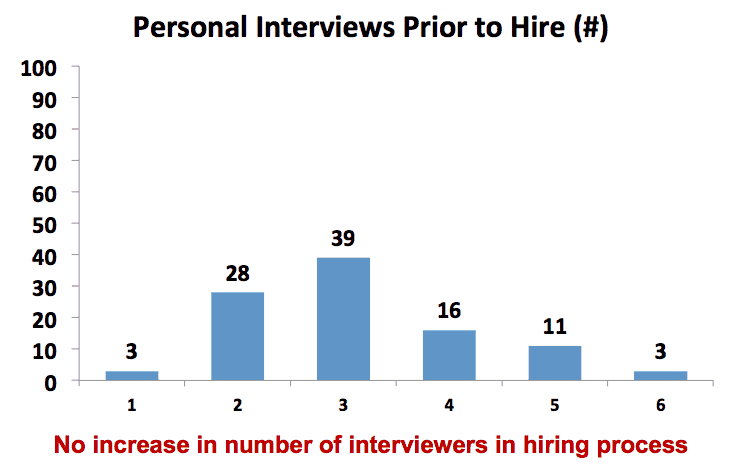
Broken Hiring Processes – In many companies, the hiring process is disjointed. Multiple people are involved in the hiring decision without clear and shared hiring criteria. This leads to confusion about the traits the employer is seeking and some great candidates can get nixed because someone misunderstands the hiring needs. Furthermore, it is often the case that people involved in the interview and hiring process have no formal training on how to interview or select candidates (in case you need it, here are some tips on how to interview sales candidates). As sales expert Dave Stein points out, “a key to successful hiring is objectivity. Hiring salespeople on gut feel, the old-fashioned way, doesn’t work.”
It takes a lot of hard work and effort to attract and hire great sales people. High producing sales organizations know that the odds of attracting sales talent is greatly increased when top performing sales people are immediately recognized and given the attention they deserve.
Before Peak, Eliot spent more than 20 years building and leading companies, where he took the lead in recruiting and managing high performance sales teams. He co-founded Ventrada Systems (mobile applications) and GlobalX (e-commerce software). He was also Vice President of Sales for PointShot Wireless.Eliot received his B. Comm. from Carleton University and has been honored as a Top 40 Under 40 Award winner.
He co-authored Sales Recruiting 2.0, How to Find Top Performing Sales People, Fast and provides regular insights on sales team management and hiring on the Peak Sales Recruiting Blog.
As we have written about before, top performing B2B sales people want to work for industry leading and highly reputed companies which their chances of success are greatest. Since there is excess demand for the services of top sales people, why wouldn’t they be selective in who they work for? In an Internet dominated world, a key question for employers is how much value the best sales professionals assign to the online reputation of an employer when deciding whether or not to be engaged in their recruiting process? And, what can I, as an employer, do to ensure that our online presence and reputation doesn’t interfere with recruiting efforts?
How much does online reputation matter for employers?
Top sales professionals, whether they are a rep or a sales VP, are passive. They are leaders in their space because they not only hit, but exceed their sales goals year after year. They win deals because they do their due diligence on prospects and don’t waste time; they are efficient. Furthermore, they have excellent compensation packages and are not usually interested in making a move because they are set-up to succeed in their current role. So when trying to attract the best-of-the-best, it is important that you, regardless of your position in the company, ensure your company puts its best foot forwarded when headhunting ‘A’ level sales candidates.
Often, the first exposure a candidate will have with your company is online. Perhaps the candidate will enter the url of your company and check out the website directly. Most likely, candidates will Google the company name to see what top search results are returned. Usually sites like the organization’s LinkedIn company page and Google+ page will be high on the list. But remember how top sales performers do their due diligence, instead of stopping at a basic Google query, they will enter “company X + reviews” or “working at company X”. These searches can return information that will make or break your sales recruiting efforts.
In this day and age, companies that don’t have an exceptional online presence are simply not going to attract A level talent”
Perhaps the most important detail that candidates look at is, of course, customer reviews. These reviews are arguably the lifeblood for an organization since they are tell-tail factors of whether or not the product or service provided has actually been embraced by the market. Things like business awards, a testimonial page, case studies, and a sizeable social media following (depending on B2B vs B2C organizations) do most of the ‘talking’ about where your organization ranks at the end of the day. Bottom line, if your organization has no ‘proof’ that its deliverable has a fan base, you can forget about attracting the best-of-the-best.
In a close second to customer reviews are employee reviews. Often posted by past employees, but sometimes posted by current ones, online sites like Glassdoor.com, Indeed.com, LinkedIn, and Vault.com provide an avenue for candidates to be armed with a dump truck full of knowledge about their potential employer. While the reviews posted on sites like those listed above are often, and rightfully so, taken with a grain of salt by candidates, their ability to influence should not be underestimated.
Monitor and Develop
Luckily there is a way to fight back, especially against those employees who left with a sour taste in their mouth. It’s simple, world class employers not only showcase their customer’s rave reviews but actually quote some of the things current employees are saying about why they love to work at their company..
Take one of our favorite clients, Thomson’s Online Benefits, for example. Not only do they talk about their “bright, clean, modern and just a little bit different” working space, but they also talk about how keeping their employees healthy and “alleviating those mid-afternoon energy slumps” by providing a “seasonal selection of free fruit in the office.” Furthermore, as you can see in the picture below, they actually showcase their Pay and Benefits awards and have a short Q & A with one of their team members on what it’s like working there.
Show casing awards and the working environment are just a few of the ways your organization can amplify its online attractiveness to ‘A’ level sales talent. Try doing a case study of on one of your reps that has rising up the ranks. In it, be sure to identify what originally attracted the candidate to the organization, how management provided the tools for the candidate to succeed from day one, and how they are now impacting the current working environment. Put it this way, just as sales prospect respond best to the success of others, so do sales candidates.
Another option which Human Resources and your organization’s Marketing department could undertake is to conduct a short, 2-3 minute video interview with the President or CEO where he or she discusses why your organization is a great place to work and make a fantastic living. If you are hiring a sales rep, do a video with the individual who would be managing them too.
Bottom line, in the war for talent, it is worth investing to ensure that your company looks and sounds it’s best online since an active, positive online reputation is one of a firm’s most strategic and valuable assets.
TIP: work with your marketing and PR departments to fine-tune your online presence.
Before Peak, Eliot spent more than 20 years building and leading companies, where he took the lead in recruiting and managing high performance sales teams. He co-founded Ventrada Systems (mobile applications) and GlobalX (e-commerce software). He was also Vice President of Sales for PointShot Wireless.
Eliot received his B. Comm. from Carleton University and has been honored as a Top 40 Under 40 Award winner.
He co-authored Sales Recruiting 2.0, How to Find Top Performing Sales People, Fast and provides regular insights on sales team management and hiring on the Peak Sales Recruiting Blog.
Let’s be honest. Not all sales conferences are created equal. You probably don’t even remember the worst conferences you ever attended. After all, they were far from memorable, but suffice it to say you ducked out as soon as possible, feeling like you would never get that time back. With so many conferences to choose from, and so many that don’t live up to their promises or can’t justify your time, how do you make sure you pick one that’s worth your time (and money)?
Use a Structured Approach:
Like everything we advocate in our sales hiring philosophy, we believe in a structured approach. Haphazardly selecting conferences to attend and showing up without any preparation leaves conference ROI to chance. We recommend following a defined process to help ensure the next sales conference you attend is a catalyst for real results.
Don’t worry; it’s easier than it sounds.
Set Desired Outcomes:
Start by jotting down some outcomes that would make a sales conference worthwhile for you.
Here are a few we came up with:
Network with thought leaders, peers, new client prospects, and potential sales team recruits.
Gather competitive intelligence for benchmarking, insight, and strategic planning.
Brainstorm new ideas to improve your company’s processes and performance.
Learn from industry experts sharing their own successes and failures, tactics and strategies, and tools and technologies.
Sell your company’s services to existing and new leads when relevant and appropriate.
Get actionable insight on the trends, developments, and forecasted changes in your industry.
Determine Selection Criteria:
Now that you know your desired outcomes, use them to come up with appropriate selection criteria to determine the conferences that are most likely to produce those outcomes.
For example:
Large (250+) number of participants.Why? Higher attendance means more chances to broaden your network, gain actionable insights, and uncover new opportunities.
Targeting B2B sales executives and managers. Why? The content will be tailored specifically for you!
Cost $300 or more to attend.Why? Amazing speakers deliver amazing value…and charge for it.
Pick a Conference:
We used the above criteria to compile our own list of 2015 sales conference recommendations:
Hosted by Selling Power, this is a high profile series of events typically held in four or five different U.S. locations each year. The Sales 2.0 conference focuses on helping sales leaders leverage Sales 2.0 technologies and strategiesto optimize operations, enablement, and marketing performance. The 2014 San Francisco event featured 40 speakers, including Jim Dickie of CSO Insights and executives from Selling Power, Xactly Corporation, and Oracle.
Hubspot strives to inspire, teach, and empower sales and marketing leaders to transform their businesses in its annual INBOUND conference. The 2014 event hosted 7,500+ marketing and sales professionals from around the world, an impressive list of speakers (including Martha Stewart, Simon Sinek, Malcolm Gladwell, Guy Kawasaki, Jill Konrath, and Marcus Sheridan), an INBOUND Rocks evening event, INBOUND Happy Hours, and Club INBOUND (the lounge at Hubspot HQ).
Hosted by salesforce.com, Dreamforce boasts a 95% recommendation rate by its past attendees. Past speakers have included Hillary Rodham Clinton, Al Gore, Tony Robbins, and Jill Konrath. The innovation-focused conference offers over 1,000 breakout sessions, sales-focused themes, reduced-cost salesforce.com training and certification opportunities, and a gala and benefit concert.
The Sales Force Productivity Conference focuses on sales strategy and operational effectiveness; sales force technology, motivation, incentives, and compensation; and sales manager education and development. Hosted by the Sales Management Association, this event promotes collaboration among attendees, speakers, and solution providers for a more personalized experience.
As its name implies, this event’s claim to fame is its focus on improving the conversations between your salespeople and your customers. Attendees gain insight into all types of conversations, from differentiation to justification to deal maximization. The 2014 conference featured 20 speakers and 40 sessions emphasizing the importance of sales and marketing alignment and compelling story creation and delivery. Conversations That Win also includes a “BIG” evening entertainment event.
Ready, Set, Go!
Once you’ve selected the conference that’s most aligned with your desired outcomes, apply these tips for extra assurance that you’ll get game-changing results from your experience:
Set auto-responders on your email and voice mail so you don’t feel the need to check them constantly. Instead, use your downtime to engage with as many people as you can. Jump in the coffee line, and strike up a conversation with the people next to you. Sit with someone different at each meal.
If you do find yourself on your smartphone, get on Twitter. Participate in the event hashtag to connect with other attendees and keep a pulse on the conference. Tweet takeaways from the sessions you’ve attended so far to share knowledge with your network. (You took notes, right?)
Talk less, listen more. Show a genuine interest in the stories of the people you meet. Maybe you can help them solve a problem. Maybe they can help you solve one?“It’s no longer about interrupting, pitching, and closing. It’s about listening, diagnosing, and prescribing.” – Mark Roberge, SVP of Sales and Services at Hubspot
Don’t be afraid to approach a speaker. These folks may be famous, but they’re there to help you. Just do your homework and pay close attention during their speeches so you can ask thoughtful questions.
Speaking of homework, research the speakers, sponsors, exhibitors, and attendees in advance. Have a specific game plan for each person you want to meet. Review the conference agenda. Schedule meetings during session breaks with anyone on your list that you’re able to reach in advance (but don’t book all of your time).
Keep an open mind. Remember your list of desired outcomes, and consider these words of wisdom from Jill Konrath: “Sometimes a change in perspective changes everything.”
Focus on action. Conference speakers will share a plethora of stories, insights, and wisdom, but keep your ear tuned for actionable advice. If you hear a tip you can implement immediately, write it down or star it in your notes. Write down any necessary action items on the back of new contacts’ business cards.
Follow up. Share key takeaways from the conference with your team. Put ideas into action. Thank attendees and speakers who gave you their time and insights. Fulfill any commitments you made to new acquaintances or prospects to send them additional information, make further introductions, etc
Focus on Priorities – While we suggest keeping an open mind, if there are some sessions that don’t offer lessons that are immediately useful, feel free to use the time to make calls and get some work done. Sometimes it only takes one or two really good sessions to make a whole conference worth the investment.
What sales conferences will you attend in 2015? Are there any we missed that deserve a mention? Let us know in the comments.
*Note: 2015 dates for some of the annual conferences had not been announced as of the date this article was written. Post will be updated as information becomes available.
Before Peak, Eliot spent more than 20 years building and leading companies, where he took the lead in recruiting and managing high performance sales teams. He co-founded Ventrada Systems (mobile applications) and GlobalX (e-commerce software). He was also Vice President of Sales for PointShot Wireless.
Eliot received his B. Comm. from Carleton University and has been honored as a Top 40 Under 40 Award winner.
He co-authored Sales Recruiting 2.0, How to Find Top Performing Sales People, Fast and provides regular insights on sales team management and hiring on the Peak Sales Recruiting Blog.
Many sales managers accept the 80-20 rule – that 20% of their reps make 80% of the sales – which I suppose is acceptable if the sales manager is consistently meeting targets, but it certainly is not a recipe for superior results. There are many downsides to allowing under-performers to exist on your sales team. Sales leaders who regularly exceed targets are vigilant about removing the weak performers from sales force.
“Traditionally, sales teams fall into a pattern: Twenty percent hit well above target – they are your high performers; 60 hit their target fairly consistently – they are your workhorses; and another 20% underperform” Colleen Francis – Nonstop Sales Boom
Wasted time and effort
While it is customary for sales leaders to pay more attention to their best reps and neglect the weaker ones, the poor performers require an inordinate amount of coaching and management time relative to their output. As a young sales manager for a B2B Internet solutions company I had two reps on my team that weren’t hitting targets. As I was unused to aggressively pruning my teams at this point in my career, I tended to work with each rep as they suffered through their troubles. I would spend considerable time coaching them through account strategies and in many cases, reworking their proposal to fix basic mistakes. It didn’t take me long to realize that my time was better spent on finding more capable reps.
U.S. managers waste an average of 34 days per year dealing with under-performance. Senior executives claim they spend seven weeks a year — or over an hour per day — managing badly performing employees. – Inc. Magazine
Under-performers do more than hamper results
Anyone who is missing their goals, is not an overly happy person. Reps are no different. In spite of the perception that reps are overly optimistic and eternally happy folk, they are emotional and can become sullen when they are not succeeding. Just as positivity is infectious, so is a negative attitude. Furthermore, when some people get in a rut, they take it upon themselves to actively bring others down with them.
In one of my previous companies, an unhappy team member acted like a contributing and “on-board” member of our team during sales meetings, but outside the meetings she opposed the direction we were going in and was verbal about it to others, trying to solicit support for her viewpoint and undermining our efforts to execute on our plan and create momentum.
Lost Opportunity
Once after terminating a rep for lying to a prospect, I made calls to the accounts the rep was managing and learned that while the customer liked the benefits they received by using my company’s products, they were reluctant to refer us to others since they really didn’t like the rep that they were dealing with. This situation was salvaged by assigning a new rep to the account, but how many other opportunities were lost because we were unaware of the dislike for our rep? Research shows that customers are far more likely to share bad experiences with companies than good experiences. How much bad buzz did our unlikeable rep create?
66% of B2B customers stopped buying after a bad customer service interaction.
95% share bad experiences.
54% shared bad experiences with more than five people
45% share bad customer service experiences and 30% share good customer service experiences via social media
Survey: The impact of customer service on customer lifetime value – Dimensional Research / Zen Desk
Morale
Top sales achievers take a lot of pride in the companies that they choose to work for. Poll your best sales producers and you will find that they are annoyed when some people don’t meet the performance goals that would justify their role on the team, but are allowed to remain as a team member. Over time this frustration can boil over and cause a good rep to consider moving to a company with higher standards. As a sales recruiter, we see this all the time and make a living out of meeting great sales people who are open to considering a career change.
Replace the weak with the strong
Perhaps the biggest reason for rejecting the 80/20 rule of sales rep output is that the gains of replacing low achieving reps are huge. Consider this – if you replace a rep performing at 70% of target with a rep at 120% of target, you get a 50% boost in sales output with less management effort. Win-win.
There are a lot of reasons why sales managers fail to trim inferior sales talent for their teams – lack of awareness, sense that there isn’t anyone available to replace the rep, fear of change are some of the main reasons – however failing to make hard choices can be the difference between success and a long downward spiral.
Before Peak, Eliot spent more than 20 years building and leading companies, where he took the lead in recruiting and managing high performance sales teams. He co-founded Ventrada Systems (mobile applications) and GlobalX (e-commerce software). He was also Vice President of Sales for PointShot Wireless.
Eliot received his B. Comm. from Carleton University and has been honored as a Top 40 Under 40 Award winner.
He co-authored Sales Recruiting 2.0, How to Find Top Performing Sales People, Fast and provides regular insights on sales team management and hiring on the Peak Sales Recruiting Blog.