For many VP of Sales and revenue leaders, scaling pipeline is not just a hiring problem. It is a structural one.
You may be seeing the same patterns:
- Sales reps working in silos
- Poor collaboration between SDRs, BDRs, AEs, and customer success teams
- Slow pipeline generation despite increased headcount
- Lack of clear ownership across accounts
- Difficulty scaling without adding complexity
High-growth B2B companies are addressing this by rethinking their sales model and adopting the right sales team structure that aligns the entire revenue team around outcomes. One of the most effective approaches is the sales pod.
This article focuses on how sales pods actually work, how they impact sales performance, and how to evaluate whether this structure fits your team.
What is a Sales Pod?
A sales pod is a small group of sales professionals organized into a cohesive unit with one shared objective. Instead of an assembly-line model where roles operate in isolation, pods function as dedicated teams aligned with a specific territory, customer segments, or a defined customer base.
Each pod operates with a shared goal and is responsible for both customer acquisition and retention throughout the customer journey.
A typical pod includes:
- Sales Development Representatives or business development reps focused on outbound sales and qualifying leads
- Account Executives are responsible for closing deals and managing multiple decision-makers across departments
- Customer Success Managers focused on expansion, retention, and meeting evolving customer expectations
In many SaaS company environments, pods may also include support from tools like Sales Navigator, HubSpot Sales Hub, or other Sales Hub platforms to streamline outreach and tracking.
The key principle is simple: the pod operates as a small group with one shared revenue objective. The pod’s one goal is to drive pipeline and revenue across the buyer’s journey, not just optimize a single stage.
How Does the Sales Pod Model Work?
Sales pods are structured around accounts and outcomes rather than isolated functions. This creates a more specific way of organizing customer-facing teams.
Core Roles and Responsibilities
Sales Development Representatives: Pipeline Creation
- Identify and engage new clients through outbound sales
- Qualify leads based on fit and intent
- Partner with AEs to align outreach with the specific needs of target accounts
Account Executives: Revenue Ownership
- Own the process of regularly closing deals
- Navigate multiple decision-makers across different departments
- Align sales efforts to sales goals and overall business outcomes
Customer Success Managers: Expansion and Retention
- Support onboarding and long-term success
- Drive expansion within the existing customer base
- Ensure customers do not become unhappy customers due to misalignment or poor handoffs
How Pods Operate
- A whole team works toward shared pipeline and revenue targets
- Clear roles ensure accountability while maintaining collaboration
- Continuous feedback loops improve deal quality and messaging
- Strong alignment across the entire customer journey improves outcomes
Pods often create a natural mentor-mentee relationship between experienced and junior team members, improving both individual and team performance over time.
Sales Pod Structure vs Traditional Sales Structure
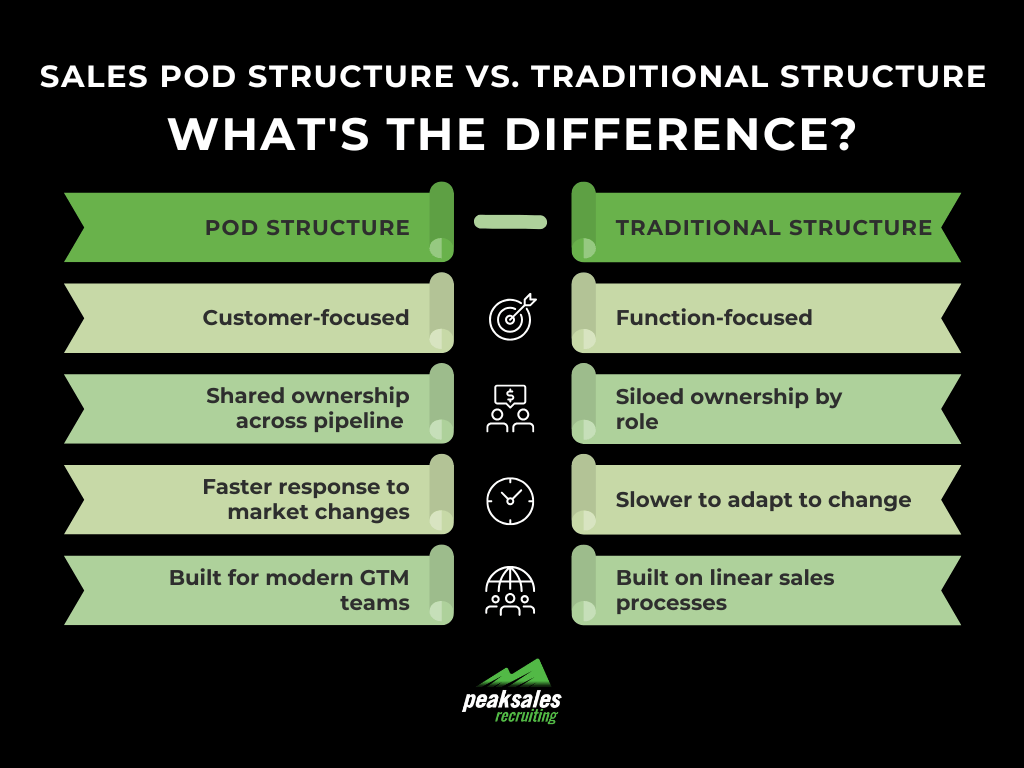
Traditional Model
- Based on an assembly line model with separate objectives
- SDRs, AEs, and CS operate in different groups with limited alignment
- Focus on functional metrics rather than key sales metrics tied to revenue
- Slower response to changing market dynamics
Sales Pod Model
- Organized as a cohesive unit with common objectives
- Shared ownership across pipeline, deals, and customer outcomes
- Designed to improve quota attainment and higher sales performance
- Better suited for remote work and modern GTM environments
Traditional structures often work for larger teams but can break down as complexity increases. Pods offer a more agile alternative, especially for companies selling into multiple industries with diverse customer needs.
6 Benefits of Sales Pods
- Better Collaboration and Communication
Pods eliminate silos between team members and create alignment across customer-facing teams.
This improves coordination across sales efforts and ensures every interaction supports the broader customer journey.
- Clear Account Ownership
Each pod owns a defined territory or segment, creating clarity and reducing friction.
This prevents overlap, ensures accountability, and supports a more efficient approach to managing clients, both new and existing.
- Faster Pipeline Generation
Close collaboration between Sales Development Representatives and Account Executives improves lead quality and prioritization.
This results in more efficient qualifying leads and faster movement through the pipeline.
- Higher Sales Performance
With aligned goals and shared accountability, pods drive higher sales performance across both individuals and the group.
Teams can focus on the right opportunities, improving quota attainment, and increasing the likelihood of regularly closing deals.
- Better Customer Experience
Pods provide a more consistent experience across the entire customer journey.
This reduces friction, aligns communication, and helps prevent unhappy customers by ensuring expectations are met from first touch through post-sale.
- Scalable and Flexible Team Design
Pods support long-term success by offering a modular structure.
Organizations can scale by adding pods rather than restructuring larger teams, making it easier to adapt to market dynamics and across industries.
This approach is particularly effective for SaaS company environments where customer segments and deal complexity vary widely.
3 Challenges of the Sales Pod Model
- Role Overlap
Without clearly defined specialized roles or specialized roles, teams may experience confusion or duplication of work.
Strong role clarity is essential.
- Need for Clear Accountability
Shared ownership requires clear sales metrics and well-defined performance expectations.
Leaders must align both individual and team performance metrics to ensure success.
- Requires Strong Leadership and Process
Pods rely on simple sales processes and disciplined execution.
Leaders must define methodologies, often borrowing from agile methodologies, to ensure alignment and consistency.
Without this, pods can lose focus and drift away from their common goal.
How to Evaluate and Implement a Sales Pod Model
If you are evaluating whether pods are the right structure for your team, focus on practical execution.
- Assess your current structure
Identify where the assembly line model is slowing down the pipeline or creating misalignment - Define clear roles and objectives
Ensure each team member understands responsibilities and how they contribute to common objectives - Start with a pilot pod
Test with a specific territory or segment before scaling - Track key sales metrics
Measure pipeline velocity, conversion rates, quota attainment, and revenue impact - Refine and scale
Use insights to expand pods across the organization and build a stronger company culture around collaboration
Final Thoughts
Sales pods represent an innovative strategy for structuring modern revenue teams.
By aligning team members around a shared goal, organizations can improve collaboration, increase efficiency, and drive higher annual customer value across the entire customer base.
For revenue leaders, the outcome is a more scalable, aligned, and high-performing sales organization that is built for long-term success.
If you are designing the right sales team structure or looking to scale your revenue team, Peak Sales Recruiting can help you hire and build pod-based teams that consistently deliver results.
More Resources
For more insights on building high-performing sales teams and mastering your revenue metrics, explore the latest articles from the Peak Blog:
- Sales Performance Metrics: 16 KPIs Every Sales Leader Should Track – Peak Sales Recruiting
- MQL to SQL Conversions: How to Measure, Benchmark, and Improve – Peak Sales Recruiting
Lead Scoring Examples: 10 Proven Models for Sales and Marketing Teams