
Lead scoring is a powerful tool for modern revenue teams, yet many organizations still rely on gut instinct or surface-level automation. When marketing teams focus solely on basic engagement signals, they often miss deeper buying intent, leading sales professionals to spend time on low-quality prospects rather than high-potential leads.
Effective lead scoring assigns point values to various data points. It combines demographic and firmographic data with buyer behavior, engagement signals, and real-time data. A higher score means a better chance of conversion and increased sales readiness.
Below are 10 lead scoring examples that show how marketing teams and sales professionals identify relevant leads and move them efficiently through the buying journey.
What Is Lead Scoring?
Lead scoring is the process of assigning numerical values to leads based on explicit and implicit data, including:
- Explicit data such as the lead’s job title, company size, and industry
- Implicit scoring from website engagement, content engagement, email engagement, and social media engagement
- Prospect behavior across marketing channels
- Account-level activity from different companies
Together, these data points create a score range that reflects interest level, sales readiness, and conversion potential.
Done well, lead scoring aligns sales and marketing teams, improves forecast accuracy, reduces wasted effort, and ensures high-potential leads move to the next stage faster.
10 Lead Scoring Examples Revenue Teams Use Today
Most organizations rely on a mix of explicit and implicit data, assign point values across key attributes, and apply score degradation to prevent stagnant leads from clogging the funnel.
Here are the 10 most common scoring models.
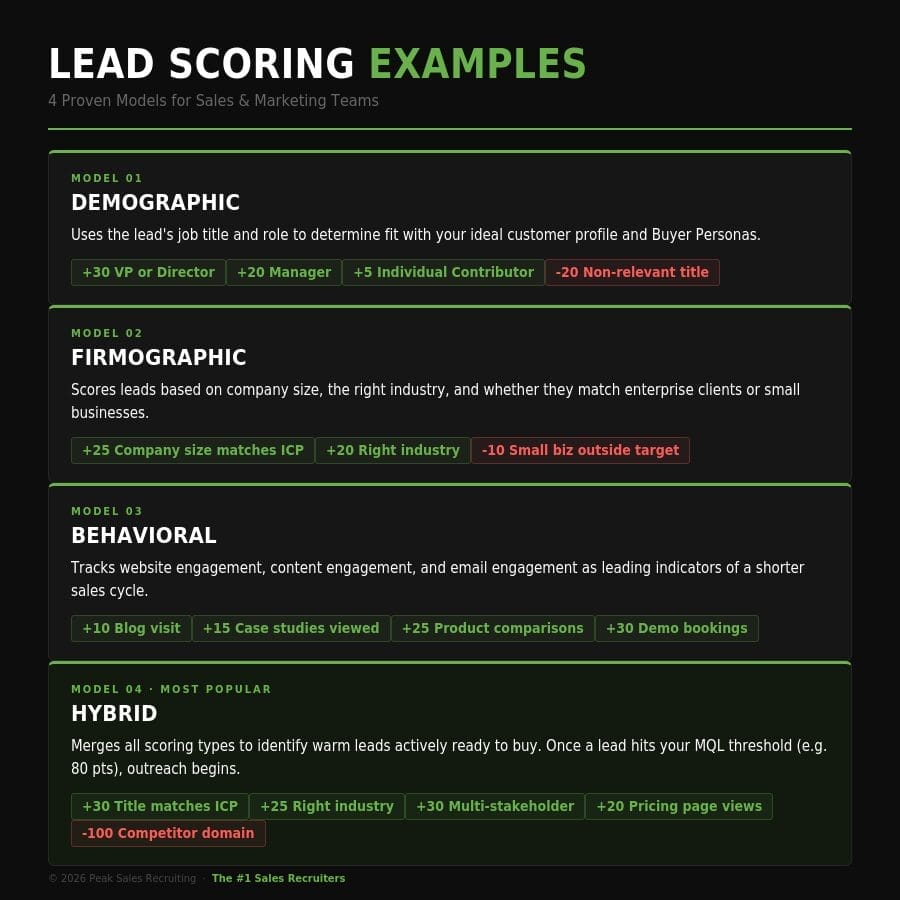
1. Demographic Lead Scoring
What it is:
Uses the lead’s job title and role to determine fit with your ideal customer profile and Buyer Personas.
Why is this important?
Helpful when selling to specific decision-makers.
Things to consider:
Job title alone does not reflect buyer behavior or sales readiness.
Sample point values:
- +30 VP or Director in the target audience
- +20 Manager
- +5 Individual contributor
- -20 Non-relevant job title
Tools To Assist: 6sense.com, Salesforce Einstein, LeadScape.
2. Firmographic Lead Scoring
What it is:
Scores leads based on company size, the right industry, and whether they match enterprise clients or small businesses.
Why is this important?
Improves lead prioritization and filters out poor-fit accounts early.
Example scoring:
- +25 Company size matches ICP
- +20 Right industry
- -10 Small businesses outside the target segment
Tools to assist: Clay, Hubspot, 6sense.com, Salesforce Einstein
3. Behavioral Lead Scoring
What it is:
Tracks website engagement, content engagement, and email engagement.
Why is this important?
Prospect engagement is a leading indicator of a shorter sales cycle.
Things to consider:
Some users show casual interest without real conversion potential.
Example point values:
- +10 Blog visit
- +15 Case studies viewed
- +25 Product comparisons page
- +30 Demo bookings
Tools to assist: Madkudu, 6sense.com
4. Engagement Scoring
What it is:
Measures the depth of interaction across marketing channels.
Why is this important?
This helps distinguish promising leads from casual browsers.
Examples:
- +10 Social media engagement
- +20 Webinar attendance
- +30 Multiple sessions in 7 days
Tools to assist: ActiveCampaign, HubSpot
5. Intent-Based Scoring
What it is:
Captures strong engagement signals tied directly to buying behavior.
Why is this important?
These signals often indicate higher conversion rates and the need for immediate follow-up.
Examples:
- +25 Pricing page viewed three or more times
- +30 Product comparisons
- +20 Sales emails opened and replied to
Tools to assist: ZoomInfo
6. Account-Based Lead Scoring
What it is:
Scores multiple stakeholders from the same account.
Why is this important?
This is a clear indicator that your lead is a high-intent opportunity.
Things to consider:
This model works well for enterprise clients and longer buying journeys.
Examples:
- +30 Two contacts from the same company are actively engaging
- +20 Decision-maker plus influencer involved
Tools to assist: 6sense.com, Demandbase, Madkudu
7. Product Usage Scoring (SaaS)
What it is:
Uses real-time data from your product to gauge interest level.
Why is this important?
Product usage is a strong predictor of conversion rates and expansion.
Examples:
- +20 Activated key feature
- +25 Invited teammates
- +30 Reached usage threshold
Tools to assist: Factors.ai, Hubspot
8. Negative Scoring and Score Degradation
What it is:
Prevents wasted sales effort by reducing scores over time.
Why is this important?
Score degradation keeps lead volume healthy and removes stagnant leads from active sales queues.
Examples:
- -15 Competitor domain
- -10 No activity for 14 days
- -25 No activity for 30 days
9. Predictive Lead Scoring
What it is:
Uses predictive analytics, machine learning, and AI-powered scoring to analyze common characteristics across closed-won deals.
Why is this important?
Predictive scoring evaluates demographic and firmographic data, buyer behavior, engagement signals, and your tech stack to surface high-potential leads.
Benefits:
- Data-driven insights
- Higher conversion rates
- Improved forecast accuracy
Tools to assist: Hubspot, Madkudu, 6sense.com
10. Hybrid Lead Scoring (Most Popular)
What it is:
A holistic method that merges many of the above options to identify the warm leads that are actively ready to buy.
Once a lead meets your MQL threshold (for example, 80 points), outreach begins with immediate follow-up.
This model supports better lead prioritization, higher conversion potential, and stronger alignment between marketing teams and sales professionals.
A hybrid approach combines:
- Explicit and implicit data
- Behavioral scoring
- Firmographic fit
- Intent signals
- Predictive analytics
Sample blended scoring:
- +30 Lead’s job title matches ICP
- +25 Right industry
- +30 Multiple stakeholders engaged
- +20 Pricing page views
- +15 Case studies
- -100 Competitor domain
How to Build a Lead Scoring Model That Works
Strong lead scoring starts with alignment.
- Define Buyer Personas and the ideal customer profile
- Map buyer behavior across marketing efforts and marketing channels
- Assign point values using multiple data points
- Review conversion rates by score range
- Set a clear MQL threshold
- Create feedback loops between sales and marketing
Marketing automation tools and marketing tools help, but alignment matters more than technology. Avoid overcomplication. Focus on relevant, promising leads and their conversion potential.
The Most Common Lead Scoring Mistakes
Even experienced teams struggle with:
- Over-scoring low-intent behaviors
- No feedback loop from sales
- Too many rules and data points
- Ignoring score degradation
- Relying on gut feeling instead of data-driven insights
These issues lead to wasted effort, poor lead prioritization, and lower conversion rates.
Final Thoughts
Lead scoring improves sales readiness, identifies high-potential leads, and supports higher conversion rates. But scoring alone does not close deals.
Once marketing efforts surface qualified prospects, success still depends on your sales professionals.
If you want reps who convert qualified leads into revenue, Peak Sales Recruiting helps companies hire proven performers who know how to follow up, personalize outreach, and close deals across complex buying journeys.
For more sales tips, tricks, and insights, visit The Peak Blog.
Recommended Resources
- Sales Assessments: What They Are, Why They Matter, and How to Use Them to Improve Sales Performance – Peak Sales Recruiting
- 15 Best Cold Calling Books Every Sales Professional Should Read
- Outbound Prospecting: A Guide for B2B Sales Teams