A clearly defined sales ICP is the cornerstone of strong, scalable, revenue-driving sales. It shapes sales efforts, guides marketing decisions, and aligns marketing and sales strategies around the same dream customer.
An ideal customer profile (ICP) defines who your team should sell to, why those clients buy, and how your solution fits into their purchasing decisions. When teams operate within their ICP, they avoid chasing deals that waste time and rarely convert. Instead, they focus on promising leads, high-potential leads, and best-fit prospects that support long-term success.
A strong sales ICP directly impacts sales productivity, conversion rates, sales forecasting, customer retention, and customer lifetime value.
What is an ICP in Sales?
A sales ICP (ideal customer profile) is a detailed profile of the type of client that delivers the highest lifetime value, the strongest average purchase value, and the most reliable long-term revenue.
Unlike buyer personas, which focus on individuals, a sales ICP operates at the account level. It considers customers’ demographics, firmographics, behavioral data, and the customer’s decision-making process.
A well-defined sales ICP answers questions such as:
- Which clients, potential clients, and existing clients convert at the highest rates?
- Which accounts show consistent buying signals?
- Where do teams see higher conversion rates and lower customer acquisition cost?
- Which customers grow into the biggest accounts over time?
A data-driven ICP helps teams focus on the current customer base while identifying new target audiences within the total addressable market.
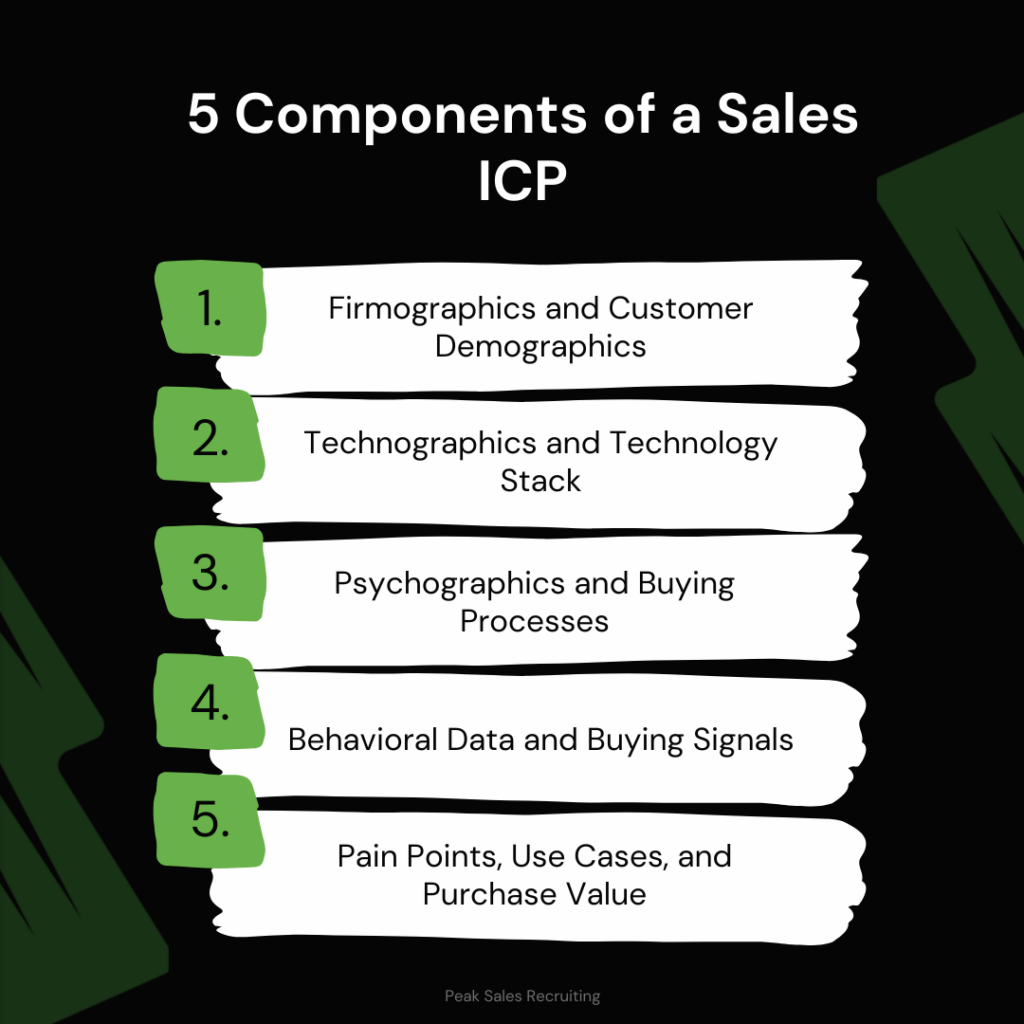
5 Components of a Sales ICP
An effective sales ICP combines reliable data, qualitative insights, and AI-powered insights to create an actionable framework for both sales and marketing.
1. Firmographics and Customer Demographics
Firmographic and demographic data define the structural traits of best-fit customers.
This includes:
- Industry and sub-industry
- Company size and revenue
- Geographic location
- Job titles and seniority
- Whether the buyer is a small business owner or part of a larger organization
These inputs reveal shared characteristics, common traits, and key differences across high-performing accounts.
2. Technographics and Technology Stack
Technographics describe a company’s technology stack or company’s tech stack.
This includes:
- CRM and core platforms
- Tools your product integrates with
- Legacy systems being replaced
- Use of conversation intelligence software or analytics tools
Understanding technographics strengthens value propositions, supports product development, and enables a more targeted approach.
3. Psychographics and Buying Processes
Psychographics explain how customers think and make purchasing decisions.
This includes:
- Risk tolerance
- Buying processes
- Engagement levels across stakeholders
- The customer’s decision-making process
These insights help teams tailor marketing messages and sales conversations to real buyer priorities.
4. Behavioral Data and Buying Signals
Behavioral data shows how accounts interact with your brand.
Examples include:
- Engagement with targeted content
- Website activity and intent signals
- Response to Ads
- Outreach performance through LinkedIn Sales Navigator
- Movement from lead to marketing-qualified lead
Behavioral data supports a more efficient customer acquisition process and helps surface best-fit prospects earlier.
5. Pain Points, Use Cases, and Purchase Value
A sales ICP should clearly document:
- Core business challenges customers are trying to solve
- Where your solution delivers measurable value
- Expected purchase value and expansion potential
This focus enables revenue-driving sales and improves overall sales productivity.
5 Reasons Why a Sales ICP is Important
1. Prevents Wasted Sales and Marketing Efforts
Without a defined ICP, sales and marketing efforts become unfocused.
A strong sales ICP:
- Improves conversion rates
- Lowers customer acquisition cost
- Reduces unqualified pipeline
- Helps teams prioritize high-potential leads
2. Enables Deeper Expertise and Long-Term Relationships
Focusing on a specific ICP allows teams to develop a deep understanding of industries, buying processes, and customer challenges.
This expertise builds trust, strengthens credibility, and supports long-term relationships with clients.
3. Aligns Marketing and Sales Teams
A shared sales ICP is critical for marketing alignment.
When a dedicated marketing team and sales organization agree on the ideal customer:
- Marketing experts produce targeted content
- Sales collateral reflects real buying processes
- Case studies highlight shared characteristics across wins
- Sales and marketing efforts reinforce each other
4. Improves Forecasting and Strategic Decisions
A defined ICP improves:
- Sales forecasting accuracy
- Pipeline quality
- Key performance indicators tied to revenue
Decisions are grounded in current customer data, current customer base insights, customer feedback, and reliable data.
5. Supports Long-Term Business Success
As a business evolves, a sales ICP helps teams adapt to market trends, incorporate new data, and maintain focus through continuous refinement.
5 Steps to Develop ICPs for Sales
Step 1: Analyze Your Current Customer Base
Start with your current customer base and historical wins.
Identify:
- Customers with the highest lifetime value
- Biggest accounts
- Accounts with strong engagement levels
- Long-standing existing clients
Step 2: Use Customer Data and Qualitative Insights
Leverage:
- Customer data from your CRM
- Customer feedback from sales and success teams
- Qualitative insights from calls and interviews
This supports a truly data-driven approach.
Step 3: Leverage Modern Sales Tools
Enhance ICP development with:
- AI-powered insights
- Conversation intelligence software
- LinkedIn Sales Navigator
- Behavioral and intent data platforms
These tools help identify buying signals and refine targeting.
Step 4: Create a Detailed ICP Profile
Document:
- Traits and key characteristics
- Target audiences and industries
- Buying processes and job titles
- Technology stack
- Core value propositions
This becomes the foundation of your sales playbook.
Step 5: Apply and Refine Continuously
Operationalize your ICP across:
- Sales efforts
- Marketing-qualified lead scoring
- Targeted content and outreach
- Sales collateral
Use performance indicators and new data to support continuous refinement.
Final Thoughts
A sales ICP is a living framework built on customer data, behavioral insights, and measurable outcomes.
When sales and marketing efforts align around the right customers:
- Sales productivity increases
- Customer acquisition cost decreases
- Conversion rates improve
- Customer lifetime value grows
Recommended Resources
- Lead Qualification Criteria Explained: What Buying Signals Matter Most – Peak Sales Recruiting
- The Future of Closing: 11 Top Sales AI Tools You Should Be Using in 2026
- AI in Sales: The 2026 Guide to a Smarter, Faster, and More Predictive Sales Landscape – Peak Sales Recruiting
Ready to Refine Your Sales ICP?
If your team is struggling with inefficient customer acquisition or inconsistent pipeline quality, refining your sales ICP can unlock higher conversion rates and long-term success.
Contact Peak Sales Recruiting to hire the best talent to align sales and marketing teams, sharpen targeting, and build revenue systems designed to scale.