
Sales content plays a critical role in how effectively your sales team connects with prospects throughout the buyer journey. Sales content is what turns insights into productive conversations and helps sales reps communicate value in a way that feels relevant and tailored to each prospect.
From case studies and webinars to product demos and blog posts, sales content gives your sales team the resources to engage prospects with clarity, handle objections directly, and guide decision making with real insight.
If you’re looking to hire sales reps who use compelling content to advance deals, contact Peak Sales Recruiting to build a team equipped with the right assets.
What is Sales Content?
Sales content includes any material or resources your sales team utilizes to educate, engage, and persuade buyers throughout the B2B sales cycle. Sales content spans everything from pitch decks and case studies to blog posts, infographics, and product demo videos.
The goal of sales content is to provide sales teams with the right resources and messaging to move prospects closer to a purchase.
Sales content should address buyer concerns, highlight value, and help your sales team communicate your solutions impact in a way that resonates with the challenge the decision maker is currently facing.
Benefits of Sales Content
- Builds buyer confidence: Providing relevant and credible information at each stage of the sales process helps prospects make informed decisions and builds trust in your solution and brand.
- Improves sales productivity: When sales professionals have quick and easy access to branded sales content, they spend less time searching for resources and more time selling.
- Aligns marketing and sales efforts: Strong sales content ensures that messaging remains consistent across marketing and sales outreach, creating a seamless buyer journey.
- Shortens sales cycles: By addressing objections and showcasing proof of value early in the sales process, sharing sales content relevant to your buyer can help move deals forward faster. Companies who utilize sales content report a 19% increase in win rates.
- Strengthens brand authority: By creating case studies, webinars, whitepapers, and other types of sales content, you position your organization as an expert in the field, giving prospects confidence that your team understands their challenges and unique needs.
7 Types of Sales Content
Market Research
Market research reports allow your sales team to stay up to date on current trends, competitor offerings, and buyer preferences. Having insights on the current market allows your sales reps to have more relevant and productive conversations, anticipate their customers needs, and customize messaging based on relevant industry data.
Beyond supporting your sales team, market research provides something of value to your prospect. Sharing insights and data-backed findings provides buyers with information they can act on. When your sales outreach consistently provides value driven insights and doesn’t always lead with a pitch, it builds credibility and naturally draws prospects toward your company.

Pitch Decks
A strong pitch deck simplifies your story. A pitch deck should include your value proposition, key differentiators, and results in a format that is easy for buyers to understand. The purpose of a pitch deck is to keep conversations structured and focused, giving your sales team a clear framework to present the value of your solution.
Whitepapers
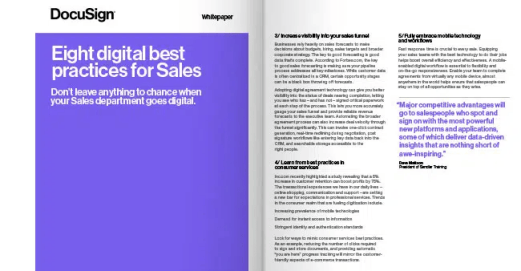
Whitepapers go much deeper into the technical and strategic side of your offering. They are often longer than an infographic and ideal for prospects in the consideration stage who want to understand how your solution works and why it is effective and relevant to their needs. By combining data, analysis, and expert insights, whitepapers help buyers make informed decisions.
Case Studies
Nothing builds buyer confidence like social proof. Case studies showcase proof of value by taking a real customer’s experience, from challenge, to solution, to measurable results, and turn it into a story that resonates with future prospects. Beyond highlighting outcomes, a case study should highlight your team’s internal process, expertise, and the ability to adapt to each client’s unique needs.

Video Content
Videos are one of the most engaging ways to communicate complex ideas and information quickly. Whether it’s a product demo, a short explanation, or a webinar, video content gives buyers a visual understanding of your solutions while keeping them engaged for longer.
- Product demo videos: Product demos allow prospects to see your offering in action. A product demo video should cover all the features of your product, the functionality, and the ease of use. The purpose of these is to help your buyer imagine how your solution fits within their current workflow.
- Webinars: An effective webinar combines education and engagement. Webinars offer an opportunity for experts to share insights and answer questions in a live format.
Blog Posts
Blog posts serve as an ongoing educational resource for your prospects and current customers. High-value blog posts build awareness, answer common questions, and position your organization as a thought leader within your industry. For sales teams, blog content can be shared directly with prospects to support conversations and provide extra content during the evaluation process.
Infographics
Infographics make data digestible. A well-rounded infographic turns complex ideas into visual insights that are quick to understand and simple to share. This type of sales content is easy to share and ideal for presentations, proposals, or social media posts that need to communicate value at a quick overview.

How to Build a Sales Content Strategy
1. Start With Your Audience
Creating an effective sales content strategy starts with knowing who you are talking to. Identify your ideal customer profile, what their goals are, and what challenges are currently keeping them from reaching those goals. The better you understand their problem, the easier it is to create impactful content that resonates.
2. Align Content with the Sales Process
89% of B2B sales buyers report that it is “important or very important” to receive relevant content at each point in the buying process. Different stages require different content.
- Awareness: Use blog posts, infographics, and market research to educate buyers and create interest.
- Consideration: Whitepapers, webinars, and case studies help your prospect evaluate their options.
- Decision: Product demos and testimonials give your buyer confidence to move forward.
3. Align Sales and Marketing Teams
Great sales enablement content comes from collaboration! Marketing ensures the message and visual stay aligned with branding, while sales provides feedback on what materials are closing deals. When those insights come together and work in tandem, the result is a stronger, more consistent buyer experience.
4. Keep it Current
Sales content is not one of those things you can set and forget. Revisit your sales materials often and check for any outdated statistics, refresh visuals, and retire any content that no longer fits your sales strategy.
5. Make it Easy to Access
The best sales content is guaranteed to go un-used if it is buried in folders and difficult to find. Follow sales content management best practices and organize assets into one dedicated platform, whether it be your CRM or a shared drive, and make sure your reps know when and how to use it effectively.
6. Track and Refine
It’s important to measure how your sales content performs. Are case studies driving engagement? Are certain blog posts getting shared more than others? Understanding what is resonating with your target audience helps you refine your approach and create more content that moves the needle.
Final Thoughts
Valuable sales content aligns your team, sharpens your brand messaging, and builds momentum across every stage of the sales cycle. When reps are equipped with the knowledge and resources of what to share and when to share it, they spend less time guessing and more time closing deals. The result? A more confident sales team and a predictable pipeline.
Looking for more ways to strengthen your sales content strategy? Explore these reads:
- If you’re focused on creating materials that directly support your sales team, our blog on sales enablement examples walks through practical sales enablement content ideas.
- For a step-by-step guide on how to build a structured approach around your sales content, read our blog on the sales enablement process.
- If you’re looking ahead to what is shaping modern B2B sales in the next year, our blog on upcoming B2B sales trends in 2026 highlights emerging trends and buyer behaviours.


