Sales leaders often struggle with inconsistency, a primary barrier to scalable growth. When sales representatives approach deals differently, marketing messaging fluctuates across the team, and new team members take too long to ramp up, consistent revenue becomes unpredictable. Without a defined sales enablement strategy, even the most talented representatives struggle to replicate the proven customer outcomes of top performers.
A well-constructed sales playbook solves this by documenting your company’s sales strategy and aligning selling techniques across the organization. It transforms “tribal knowledge” into repeatable steps that drive predictable outcomes.
This guide provides a strategic breakdown of real-world sales playbook examples, essential components to include, and guidance on building a system that supports growth for SaaS and B2B organizations.
What Is a Sales Playbook?
A sales playbook is a centralized hub of sales enablement materials, collateral, and helpful resources that guide your team’s execution. It outlines specific selling techniques, messaging frameworks, and sales plays so every rep can navigate the buyer’s journey with precision.
Instead of relying on gut feeling, reps use the playbook to implement proven methodologies like the Sandler Selling System Playbook, SPIN Selling, or The Challenger Sale. Ultimately, a great playbook answers one simple question: What does winning look like at this company, and how can we repeat it to ensure a positive buyer experience?
7 Sales Playbook Examples B2B Teams Can Use
The most effective teams do not use a “one-size-fits-all” document. Instead, they use specialized playbooks tailored to different roles and stages of the funnel.
1. Outbound Prospecting Playbook
What it is: The engine at the top of your funnel. This outbound prospecting playbook defines exactly who your reps should be targeting, how to find them, and what to say when they do.
How to build it:
- Define your ICP tightly: Go beyond industry and company size. Document the specific triggers that indicate a prospect is ready to buy, such as a new funding round, a leadership change, a product launch, or a recent competitor switch.
- Map your outreach channels: Specify which channels to use for each segment (e.g., LinkedIn for VP-level, cold email for mid-market, cold calling for SMB) and document the cadence of sequences. How many touches, how far apart, and in what order?
- Set clear activity metrics: Define daily/weekly targets: number of new prospects added, emails sent, calls made, and LinkedIn messages sent. Tie these to pipeline creation goals so reps understand the “why” behind the numbers.
2. Discovery and Qualification Playbook
What it is: A structured guide to help reps stop wasting time on bad-fit leads and focus energy on deals they can actually win.
How to build it:
- Choose a qualification framework and stick to it: Whether you use MEDDIC, BANT, or Gap Selling, document the specific questions reps should ask and what “good” answers look like versus red flags.
- Build a question bank: Include discovery questions organized by pain category (e.g., questions around technical pain, business pain, and personal impact). Layer in follow-up probes for each.
- Define your “qualified” criteria explicitly: Don’t leave it to interpretation! Spell out what moves a prospect from MQL to SQL conversion.
3. Demo and Presentation Playbook
What it is: A repeatable framework that ensures every product demo is tailored, high-impact, and directly tied to the prospect’s stated business problems.
How to build it:
- Structure the demo around the discovery call: The playbook should guide reps to reference specific pain points uncovered earlier. Build a pre-demo checklist: What did we learn? What outcomes matter most to this buyer?
- Create modular demo flows: Instead of one rigid script, develop 3-4 core “demo modules” mapped to your most common use cases. Reps can mix and match based on the prospect’s priorities.
- Include a “so what” prompt for every feature: For each capability shown, the playbook should prompt the rep to link it to business impact: “This means your team saves X hours per week” or “This eliminates the manual process you described.”
- Prepare for live objections: Include a section on common mid-demo questions and objections (e.g., “How does this integrate with our current stack?”) with suggested responses that keep the conversation moving forward.
4. Objection Handling Playbook
What it is: A practical reference guide that equips reps to handle pushback on price, timing, competition, or internal buy-in, without going off-script or losing momentum.
How to build it:
- Catalogue your top 10-15 objections: Pull from CRM notes, call recordings, and loss analysis. Group them into categories: pricing, timing, competitor preference, internal stakeholder resistance, and “not a priority right now.”
- Write a response framework for each: Use a structure like Acknowledge > Reframe > Respond > Confirm. Avoid scripted rebuttals that sound canned and give reps language they can make their own.
- Include “trap” objection: Some objections are actually buying signals in disguise (“This is more than we budgeted”). Teach reps to recognize these and respond with curiosity rather than concession.
- Log what actually works: Track which responses lead to deals moving forward versus stalling. Update the playbook quarterly based on real win/loss data, not gut feeling.
5. Closing Playbook
What it is: A step-by-step guide for navigating the final and often most complex stretch of a deal, from proposal creation through contract signature.
How to build it:
- Map out the typical closing sequence: Document each task in order: mutual action plan review, proposal delivery, procurement/legal intro, executive alignment call, negotiation, and signature. Assign ownership for each step.
- Create a mutual action plan (MAP) template: This is a shared document between the rep and the buyer that outlines what both sides need to do to get the deal closed by a target date. It keeps momentum and creates accountability on both sides.
- Prepare negotiation guardrails: Define what reps can offer without escalation (e.g., payment terms, minor discounts) versus what requires VP sign-off. Include common negotiation scenarios and recommended responses.
- Define “deal at risk” signal: Teach reps to recognize when a deal is stalling, radio silence after a strong demo, delays on legal review, a sudden change in champion, and give them a protocol for re-engaging or escalating.
6. Account Management and Expansion Playbook
What it is: A guide to maximizing revenue from existing customers through retention, relationship building, upsells, and cross-sells. Revenue doesn’t stop at the first signature.
How to build it:
- Define your customer health scoring model: What signals indicate a healthy account versus one at risk? Build a scoring framework using product usage data, support ticket volume, NPS, and engagement frequency.
- Create an expansion trigger list: Document the specific events that should prompt an upsell or cross-sell conversation, such as a customer hitting usage limits, a new hire in a key role, a department expansion, or a positive QBR outcome.
- Standardize the QBR process: Include an agenda template, a slide framework, and prep questions that help account managers speak to business value and outcomes, not just usage metrics.
- Script the expansion conversation: Reps often feel awkward shifting from support mode to sales mode. Give them a natural segue: how to bring up new products or features in a way that feels helpful.
7. Sales Onboarding and Ramp Playbook
What it is: A structured new-hire program that gets reps to productivity faster by standardizing the onboarding experience and eliminating the guesswork of “figuring it out on the job.”
How to build it:
- Build a 30/60/90-day roadmap: Week by week, define what a new rep should know, who they should have met, what they should be able to demo, and what their pipeline targets look like by the end of each phase.
- Create a “certification” track: Before a new rep makes a live customer call, have them complete a demo certification, a cold call roleplay, and a product knowledge quiz. This protects your brand and gives reps confidence.
- Assign a dedicated ramp buddy: Pair each new hire with a top performer for their first 30 days. Document what the buddy relationship should include.
- Link to the full playbook library: Onboarding is the best time to introduce reps to the rest of the playbooks. Build in structured time for them to read and ask questions about the prospecting, discovery, and objection handling playbooks before they go live.
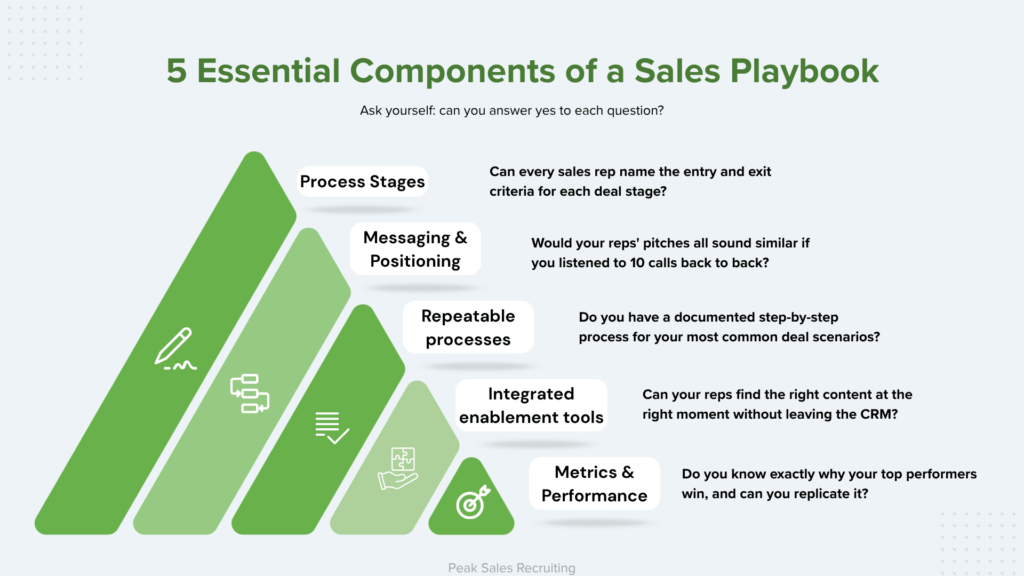
5 Essential Components of a Modern Sales Playbook
A high-performing playbook is a living system rather than a static document. To drive continuous improvement and long-term success, it must include these five pillars:
- Clear Sales Process Stages: Define the journey from prospecting to closing. Include entry and exit criteria for each phase (such as Discovery, Demo, and Proposal) to reduce pipeline variability and increase conversion rates.
- Defined Messaging and Positioning: Standardize your elevator pitches and value propositions. This section should include a company overview, detailed competitive information, and a clear Ideal Customer Profile (ICP).
- Repeatable Sales Plays: These are step-by-step guides for key tasks, including handling a stalled deal or multi-threading within a complex account organizational chart.
- Integrated Enablement Tools: Your playbook should link directly to CRM workflows. High adoption occurs when ready-made content, such as data sheets and question banks, is available at the point of need.
- Metrics and Performance Frameworks: Define the KPIs that matter, such as average deal size, pipeline velocity, and sales quotas. This creates a data-driven culture of accountability.
How to Build and Optimize Your Sales Playbook
To build a playbook that actually gets used, follow this structured approach:
- Audit the “Winners”: Interview your top 5% of performers. Determine how they position your offerings and document their specific strategies.
- Integrate with Tech: Do not hide your playbook in a folder. Embed your sales plays directly into your CRM or sales enablement platform.
- Iterate Constantly: Treat your playbook as a “Beta” product. Update it every quarter based on new competitor moves and win/loss data.
3 Common Mistakes to Avoid:
- Making it too generic: If your playbook could apply to any company, it will not help yours.
- Ignoring Adoption: A playbook only works if it is reinforced through sales coaching.
- Static Documentation: Markets change. If your playbook is a year old, it is likely obsolete.
Final Thoughts
The best sales playbook examples are not just theoretical guides; they are practical toolkits that empower reps to sell with confidence. By standardizing your process and centralizing your best resources, you create a foundation for a predictable, high-performing sales organization.
More Resources
For more insights on building high-performing sales teams and mastering your revenue metrics, explore the latest articles from the Peak Blog:
- Sales Motivational Quotes to Inspire High-Performing Sales Teams – Peak Sales Recruiting
- Sales Pods: How High-Growth B2B Teams Structure for Faster Pipeline and Revenue
- B2B Sales Enablement: How to Build and Scale Your Sales Process – Peak Sales Recruiting